

 EN-GB
 Nederlands
 Deutsch
 Français
 Español
 Italiano
 Polski
 Svenska
 Deutsch (Belgien)
Maintaining pH and ORP probes: how to keep your measurements reliable
pH and ORP probes are indispensable for a healthy swimming pool or aquarium. Without maintenance, they lose their precision due to deposits, dirt and drying out. Clean them regularly, store them moist in KCl solution and calibrate them with fresh buffer solution. That way your measurements stay reliable and your probes last longer. Meytec offers all the solutions and accessories you need for optimal maintenance.
What are pH and ORP probes?
A pH probe measures the acidity of the water. In swimming pools, a pH between 7.0 and 7.6 is ideal for both swimmer comfort and the effectiveness of chlorine. In aquariums, a stable pH is crucial for the well-being of fish and plants.
An ORP probe (redox) measures the oxidation-reduction potential, expressed in millivolts (mV). This value indicates how strongly the water oxidises and therefore how effective the disinfection is. In swimming pools, an ORP between 650 and 750 mV is recommended for safe pool water.
Both probes work with a glass membrane (pH) or a precious metal such as platinum or gold (ORP) in combination with a reference electrode. They are therefore sensitive to contamination and drying out.
Why maintenance is necessary
pH and ORP probes only measure reliably if the glass membrane and the reference junction are clean, hydrated and undamaged. Poor maintenance leads to slow responses, deviating values and a shorter service life.
In swimming pools and aquariums, electrodes have to deal with:
- Limescale from hard water
- Grease and organic contamination (skin oils, sun cream, fish food)
- Algae and biofilm in warm, humid environments
- Drying out when the probe is not stored moist
The result? The offset and slope of the electrode shift, making your measurements slowly but surely unreliable.
The benefits of good maintenance:
- Stable, reproducible readings
- Shorter response time
- Longer service life of the probe
- Fewer measurement errors and unnecessary corrections
How do you clean pH and ORP probes?
Cleaning is simple, but you need to work carefully. The glass membrane of a pH probe and the sensitive ORP sensor are fragile.
Why cleaning is really necessary
A pH or ORP probe is an electrochemical sensor. The measurement takes place at the surface of the glass membrane (pH) or the platinum/gold measuring electrode (ORP). As soon as a layer of limescale, grease, protein or biofilm forms there, the measuring surface becomes isolated from the water. The result: slow response times, deviating values and an offset that falls outside the permitted margin.
How cleaning solution works
Cleaning solutions for electrodes tackle this problem in two ways:
- Dissolving mineral deposits (limescale)
Limescale (calcium carbonate) does not dissolve in water. Cleaning solutions therefore contain a mild acid or a chelating compound that binds calcium and magnesium ions. As a result, the limescale layer dissolves without attacking the glass or the reference junction. With a general cleaning solution, this usually takes 15 minutes. - Removing grease, protein and organic material
Grease and protein contamination (skin oils, sun cream, fish food, algae) adheres to the measuring surface via hydrophobic bonds. Cleaning solutions contain surfactants that break these bonds and bring the contamination into solution. For specific applications there are separate cleaners: protein remover for aquariums with a lot of fish food, grease remover for swimming pools with a lot of sun cream, and alkaline cleaners for meat and fat residues.
Step 1: Rinse after every use
Always rinse the probe with clean water (tap water or demineralised). This removes immediate contamination and prevents residues from building up.
Step 2: Cleaning solution for stubborn deposits
Immerse the probe for about 15 minutes in a special cleaning solution for electrodes. This effectively removes limescale, grease and biofilm. Meytec offers a cleaning solution specially developed for pH and ORP probes.
Step 3: Rinse thoroughly and rehydrate if necessary
After cleaning, rinse the probe thoroughly with clean water. Has the probe dried out badly? Then place it in KCl storage solution for an hour to rehydrate.
Why not just wipe it with a cloth?
Rubbing with a cloth or brush can cause microscopic scratches in the pH glass. Every scratch changes the electrical properties of the membrane and causes measurement errors. Static charge on the cloth can also disturb the sensitive measurement. Cleaning solution does the work without mechanical stress.
Why calibrate after cleaning?
During calibration, the meter assumes that the probe is clean. If there is still a layer of contamination on the measuring surface, the calibration curve is based on a contaminated surface. As soon as that contamination later comes loose, the calibration is no longer valid. By cleaning first and calibrating afterwards, you can be sure that the offset and slope are correct.
How do you store pH and ORP probes?
Storage is perhaps even more important than cleaning. A probe that is stored incorrectly can be permanently damaged within a few days.
Always store moist
The glass bulb (pH) and the reference junction (pH and ORP) must always remain moist. Always store the probe in the protective cap filled with KCl storage solution 3 mol/l.
How storage solution works exactly
The storage solution, also known as 3 mol/L KCl solution, does three things at once:
- Keeping the glass membrane hydrated
The pH glass of a probe is covered with a so-called swelling layer (hydrated gel layer). This is an ultra-thin layer of about 0.1 micron into which hydrogen ions (H⁺) can penetrate, generating the potential difference that determines the pH. This swelling layer must remain wet at all times. If the probe dries out, the swelling layer disappears, and without a swelling layer the probe no longer measures. Storage solution keeps this layer intact. - Keeping the reference junction open and stable
The reference electrode (Ag/AgCl) is in contact with the sample water via a porous junction. A small amount of KCl continuously migrates outwards through that junction. If the probe is stored in distilled water, an osmotic effect occurs: the concentrated KCl in the reference cell diffuses into the water, so that the ionic strength in the reference drops and the reference potential shifts. The result is a permanent deviation. Storage solution with 3 mol/L KCl has the same ionic strength as the internal reference solution. There is then no osmotic pressure, and the junction stays open and stable. - Maintaining the correct ion balance
KCl is used because potassium (K⁺) and chloride ions (Cl⁻) have almost the same mobility. As a result, only a minimal diffusion potential arises at the junction. Other salts, such as NaCl, would cause a measurable deviation.
Never in distilled water
Never store the probe in distilled or demineralised water. This draws ions out of the reference cell and damages the probe permanently. It also evaporates faster, which makes the glass dry out.
Dried-out probe?
Has the probe dried out anyway? Then place it in storage solution for at least an hour — but preferably overnight — to rehydrate. The swelling layer then hydrates again. If that does not work, the probe is usually permanently damaged.
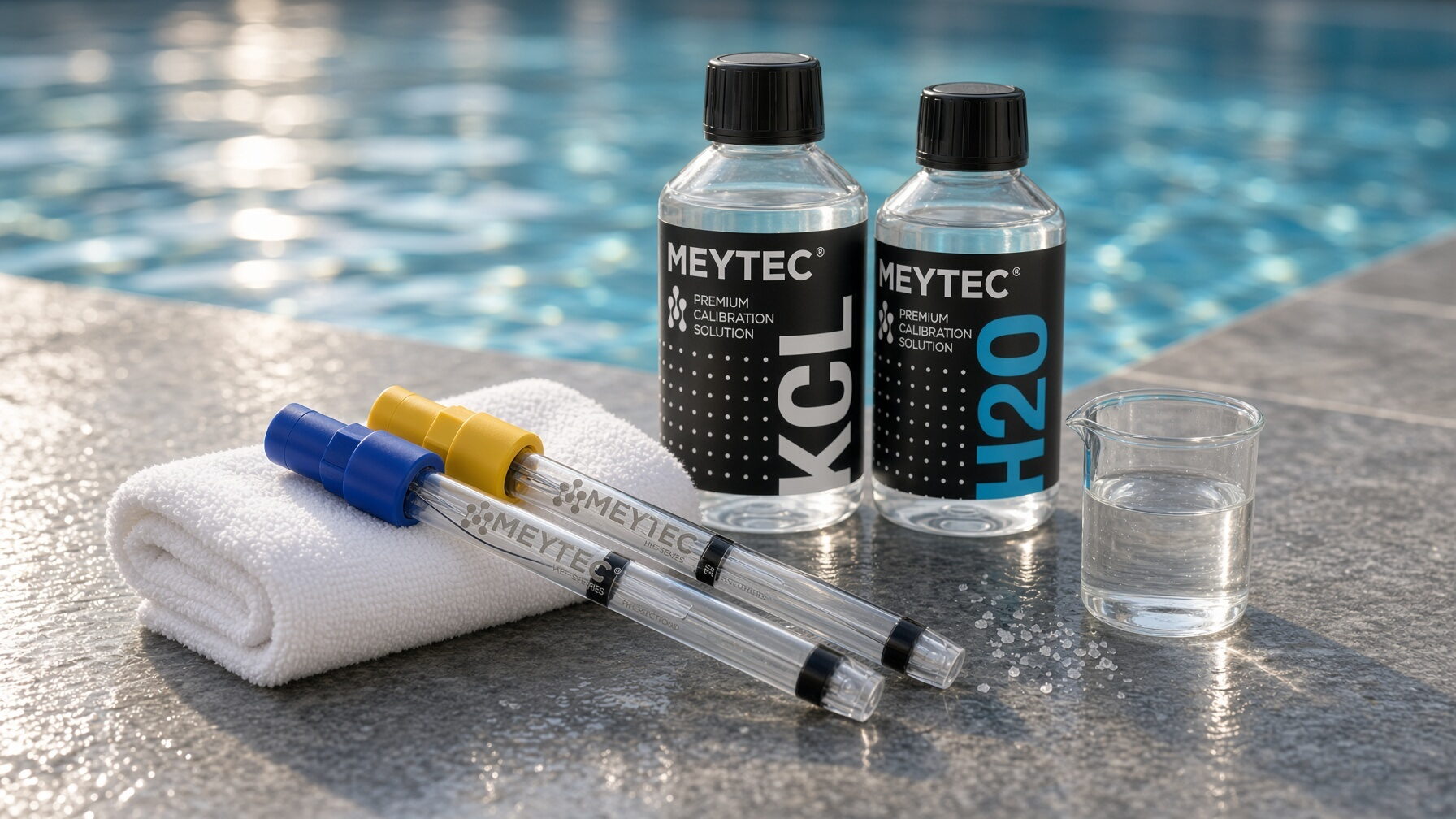
Meytec supplies KCl storage solution in various packaging, including 250 ml bottles and handy 20 ml sachets.
Do not forget to calibrate
Even with good maintenance, pH and ORP probes need regular calibration. Calibration keeps the probe accurate and limits measurement errors. As explained above: always calibrate after cleaning, so that the offset and slope are set on a clean measuring surface.
Frequency:
- Daily use → calibrate daily
- Occasional use → at least weekly or monthly
- After cleaning the probe
- If manual test results differ from the probe reading
For pH probes, use fresh buffer solution, at least two points: usually pH 4 and 7, or pH 7 and pH 10. Meytec offers buffer solutions in 250 ml, 60 ml and 20 ml.
For ORP probes, use an ORP buffer solution, for example 475 mV, 468 mV or 650 mV. Meytec supplies these in various packaging, including handy 20 ml sachets.
Always follow the manual of your measuring device for the exact calibration procedure. Used buffer solution is no longer accurate after about 20 minutes — pour it away and do not reuse it.
With good maintenance and regular calibration, your pH and ORP probes will keep measuring reliably for years — whether it is a crystal-clear swimming pool or a healthy aquarium. Meytec offers a complete range of probes, buffer solutions, cleaning agents and storage solutions to support you.
Related: calibration packs, probes.


