

















Free shipping from €100
EN
AustriaDE
BelgiumDEFRNL
BulgariaBG
CroatiaHR
CyprusEL
CzechiaCS
DenmarkDA
EstoniaET
FinlandFI
FranceFR
GermanyDE
GreeceEL
HungaryHU
IrelandEN
ItalyIT
LatviaLV
LithuaniaLT
LuxembourgDEFR
MaltaEN
NetherlandsNL
NorwayNO
PolandPL
PortugalPT
RomaniaRO
SlovakiaSK
SloveniaSL
SpainES
SwedenSV
SwitzerlandDEFRIT
United KingdomEN

Blog

  • pH and aquariums

    pH and aquariums

    pH and aquariums: why it is the key to healthy underwater life

    A stable pH value is perhaps the most underestimated factor in the aquarium hobby. While many aquarium enthusiasts focus on temperature and feeding, the acidity of the water determines whether fish, plants and beneficial bacteria actually thrive. In this blog we take a deep dive into the world of pH, from the biological necessity to the latest measuring equipment, and look at how Meytec products help keep your aquarium in balance.

    Why is pH important for an aquarium?

    The pH value indicates how acidic or alkaline the water is, on a scale of 0 to 14. A value of 7 is neutral, lower is acidic and higher is alkaline. But why does this matter so much?

    For fish: stress, disease and death

    Fish are extremely sensitive to pH fluctuations. A deviation of more than 0.3 pH per day can already cause stress. That stress lowers resistance, makes fish susceptible to disease and in serious cases can even lead to death. In addition, an incorrect pH has a direct influence on the toxicity of ammonia: the higher the pH, the more ammonium converts into toxic ammonia; especially above pH 7.5 the proportion of ammonia increases rapidly. Ammonia is fatal even in small amounts.

    For plants: nutrient uptake and growth

    Aquatic plants only absorb nutrients well within a certain pH range. At the wrong acidity, essential minerals such as iron and manganese can precipitate, so that plants can no longer absorb them. The result: yellowed leaves, stagnating growth and eventually dying plants. Plants also influence the pH themselves: during the day plants absorb CO₂, causing the pH to rise; at night they release CO₂, causing the pH to fall.

    For water quality and the biological filter

    The beneficial bacteria in your filter – responsible for converting ammonia into nitrate – work best at a stable pH. Extreme values slow down nitrification, causing harmful substances to build up. A stable pH is therefore not only important for the fish, but for the entire ecosystem in your aquarium.

    Big overview: which fish species needs which pH?

    The ideal pH differs greatly per fish species. Roughly speaking, there are three categories:

    South American species (soft, acidic water)

    • Discus: pH 5.5–6.5
    • Neon tetras: pH 5.0–7.0
    • Cardinal tetras: pH 5.5–7.0
    • Dwarf cichlids (Apistogramma): pH 5.5–6.5
    • Corydoras: pH 6.0–7.5

    Asian and African species (slightly acidic to alkaline)

    • African cichlids (Malawi/Tanganyika): pH 7.8–8.5
    • Barbs: pH 6.0–7.5
    • Danios: pH 6.5–7.5
    • Rasboras: pH 6.0–7.0

    Community aquarium (widely applicable)

    • Most community fish and plants thrive best between pH 6.8 and 7.4
    • Goldfish: pH 7.0–7.6
    • Livebearers (guppies, platies, swordtails): pH 7.0–8.0
    • Angelfish: pH 6.5–7.5

    Important: choose fish that suit the pH of your tap water, instead of constantly trying to adjust the pH. A stable pH is more important than an “ideal” pH.

    How do you measure pH in an aquarium?

    There are several methods for measuring the pH value in an aquarium, each with advantages and disadvantages:

    Test strips or drop tests

    Cheap, but often inaccurate and subjective due to colour interpretation. Suitable for a rough indication, but not for precision work.

    Portable pH meter (handheld)

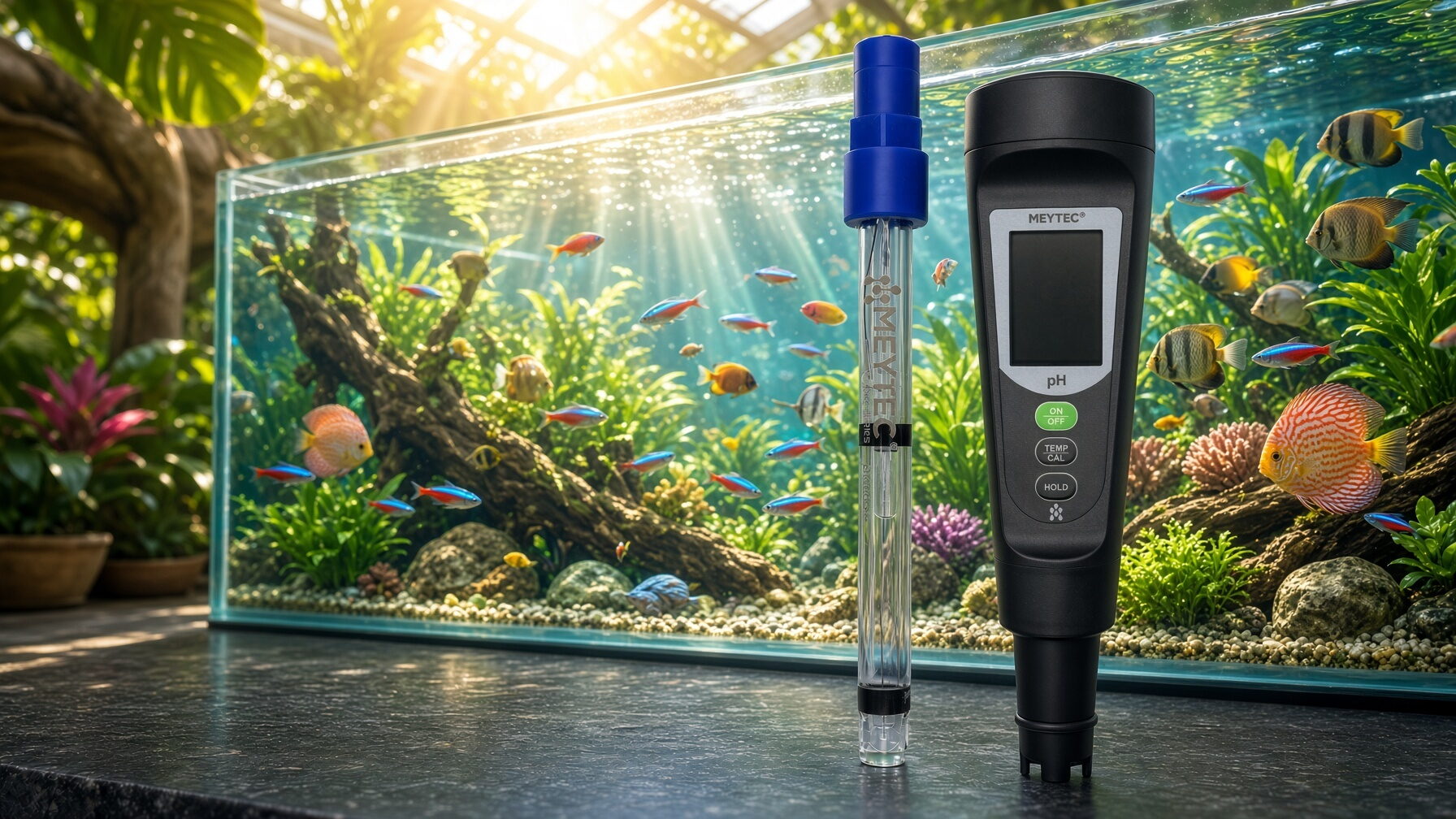
    A compact device that measures the pH value quickly and accurately. Ideal for periodic checks: daily, weekly or whenever you suspect something is wrong. The meter gives a digital value immediately and is easy to calibrate. The portable pH meter GT-500PH is a fast and accurate pH meter that lets you measure the correct pH value in no time and is easy to calibrate automatically.

    Fixed pH measuring and control system (pH probe)

    A permanently installed system in which the pH probe sits continuously in the aquarium water or in a flow cell. The system measures continuously and can even control the CO₂ supply. The pH probe is the sensitive and most critical component here – a high-quality electrode, correctly maintained and properly calibrated, determines the reliability of your measurements.

    The Meytec NXG-PH probe is a durable pH probe with a fast response that is compatible with the majority of systems on the market.

    pH dosing devices

    Advanced systems that not only measure, but also automatically dose pH correction solution. They combine a pH controller with a dosing pump and are ideal for demanding aquariums. Take a look at Meytec’s pH probes and pH buffer solutions for reliable pH measurement in your aquarium.

    Top pH brands in Europe: models and Meytec compatibility

    Important: the Meytec NXG-PH probe is compatible with any device that has a BNC input and accepts an electrode with a diameter of 12 mm.

    Brand Relevant models Compatible with NXG-PH? Required Meytec buffer solutions
    1. Hanna Instruments HI981520 Marine Monitor
    HI9813-61
    BL-7916-2 pH controller with pump
    BL-981411-0 Mini Panel Mounted pH Controller
    Yes – works with Hanna pH controllers and meters with a BNC input. pH 7 + pH 10 or pH 4 + pH 7 + pH 10
    2. Milwaukee Instruments MC122 PRO pH Controller (pH 5.5–9.5)
    MC125 PRO 2-in-1 pH/ORP Controller
    MC720 PRO pH Controller with dosing pump
    Yes – replaces the original Milwaukee pH probe. pH 7 + pH 10 or pH 4 + pH 7 + pH 10
    3. Bluelab Bluelab pH Controller
    Pro Controller Connect (Wi-Fi, doses pH and nutrients)
    Yes – works with Bluelab pH controllers with a BNC input. pH 7 + pH 10 or pH 4 + pH 7 + pH 10
    4. Mettler Toledo InLab Easy pH probe
    NineFocus NF2000 HA Kit
    SevenCompact S220
    Yes – please note: check whether your Mettler device has a BNC input (not S7). pH 7 + pH 10 or pH 4 + pH 7 + pH 10
    5. Apera Instruments PH20 Value
    PH60
    PC60 Premium
    PC400S
    Probably – devices with a BNC input and 12 mm electrode are compatible. Always check the specifications. pH 7 + pH 10 or pH 4 + pH 7 + pH 10
    6. TUNZE SmartController 7000
    pH-Controller 7070/2
    pH/CO₂ Controller 7074/2
    Probably – TUNZE uses its own pH probes. If your system has a BNC input and accepts a 12 mm electrode, the NXG-PH is compatible. pH 7 + pH 10 or pH 4 + pH 7 + pH 10
    7. EHEIM pHcontrol+e (pH 0–14, control range pH 6–9, day/night control, guided calibration, CO₂ valve control via Wi-Fi) Possibly – the pHcontrol+e uses its own pH sensor. Check the connection before purchase. pH 7 + pH 10 or pH 4 + pH 7 + pH 10
    8. GHL ProfiLux 4.1e
    ProfiLux 4
    ProfiLux Mini WiFi
    PLM-pH/Redox expansion card with BNC input
    Probably – the PLM-pH/Redox card has a BNC input. Check the specifications of your GHL configuration. pH 7 + pH 10 or pH 4 + pH 7 + pH 10
    9. Dennerle pH probe (gel electrode, 3 m cable, BNC)
    CO2 pH probe with Quali-Safe protection
    Yes – Dennerle uses a BNC connection and is suitable for all pH measuring devices with BNC. pH 7 + pH 10 or pH 4 + pH 7 + pH 10
    10. Metrohm Aquatrode Plus
    913 pH Meter
    780/781 pH/Ion Meter
    Ecotrode Plus Pt1000
    Possibly – Metrohm often uses S7 or banana plugs. Check whether your Metrohm device has a BNC input. pH 7 + pH 10 or pH 4 + pH 7 + pH 10
    11. JBL PROFLORA pH-Control Touch
    PROFLORA CO₂ pH SENSOR SET
    pH-Control (BNC connection for pH sensor)
    Yes – the JBL pH-Control and PROFLORA pH-Control Touch have a BNC connection for the pH sensor. The NXG-PH (BNC, 12 mm) is a direct replacement. pH 7 + pH 10 or pH 4 + pH 7 + pH 10
    12. Sera seramic pH Controller
    sera pH meter
    sera pH-Controller
    sera CO2-Controller
    sera pH measuring electrode (BNC, 1.5 m cable)
    Yes – the sera pH measuring electrode has a BNC plug and is compatible with sera pH meters and seramic controllers. The NXG-PH is a full alternative. pH 7 + pH 10 or pH 4 + pH 7 + pH 10
    13. Aqua Medic pH computer set (incl. pH probe with BNC)
    pH controller (pH 3.5–12.5, BNC connection)
    pH monitor
    pH/Redox controller
    CO2 controller
    pH probe
    Yes – the Aqua Medic pH controller has a BNC connection for electrodes. The NXG-PH is a direct replacement. pH 7 + pH 10 or pH 4 + pH 7 + pH 10

    Meytec GT-500PH and NXG-PH: your pH partners

    Meytec offers two products that are perfectly suited to the needs of the aquarium hobbyist:

    Meytec GT-500PH pH meter

    The GT-500PH is a compact digital pH meter that measures pH from 0.00 to 14.00 with a precision of ±0.05. It has a built-in temperature sensor with automatic temperature compensation and a dust-tight housing that is resistant to water jets (IP65, not for full immersion) – ideal for use around the aquarium. Automatic calibration at pH 7, pH 4 and pH 10 makes the device user-friendly, even for beginners. Batteries (4× LR44) are included.

    Meytec NXG-PH pH probe

    The NXG-PH is a professional pH probe with a BNC connection, a diameter of 12 mm and a 3 metre cable. It measures pH 0.00–14.00 with a precision of 0.01 pH and works at temperatures of 0–80°C. The double junction and double Ag/AgCl reference ensure stable, reliable measurements.

    Compatibility: where do these Meytec products fit?

    The GT-500PH is a standalone handheld meter: it works independently and can be used immediately in any aquarium.

    The NXG-PH is compatible with, among others:

    • Hanna Instruments (pH controllers and meters with BNC input)
    • Milwaukee Instruments (pH controllers)
    • Mettler Toledo (devices with BNC input)
    • JBL (pH measuring systems)
    • Bluelab (pH controllers)

    Maintenance and calibration: the key to accuracy

    A pH probe is a sensitive sensor. With the right maintenance, you can extend its service life considerably:

    Conclusion

    With its BNC connection, 12 mm diameter and 3 metre cable, the Meytec NXG-PH probe is a universal pH probe that is compatible with most pH measuring and control systems on the European market. Whether you use a JBL PROFLORA pH-Control Touch, sera seramic pH Controller, Aqua Medic pH computer set, Hanna controller, Milwaukee dosing system or Bluelab pH Controller: as long as your device has a BNC input and accepts a 12 mm electrode, the NXG-PH is an excellent choice.

    For correct calibration, use the Meytec buffer solutions: pack pH 7 + pH 10 + 475 mV for two-point calibration on the alkaline side, pH 4 + pH 7 for the acidic side, or pH 4 + pH 7 + 475 mV for systems that also measure ORP. Do not forget to store the probe in KCl 3 mol/l storage solution after use and to clean it with the Meytec cleaning solution before calibration.
  • Calibrating a swimming pool pH probe: a complete guide

    Calibrating a swimming pool pH probe: a complete guide

    Calibrating a swimming pool pH probe: what is a pH probe?

    A pH probe is an electrochemical sensor that measures the concentration of hydrogen ions (H⁺) in water. It is a glass probe consisting of a measuring electrode (a pH-sensitive glass membrane) and a reference electrode (usually a silver/silver chloride wire in a 3M KCl solution). The potential difference between the two is converted into a pH value.

    Why does a swimming pool pH probe need to be calibrated?

    The glass membrane and the reference electrode become contaminated over time by minerals, grease and disinfection by-products. As a result, the measurement drifts. In pool water this happens faster because of chlorine, limescale and sun cream. Without calibration, a deviation of 0.1 to 0.3 pH can already lead to incorrect dosing of chemicals, resulting in cloudy water, reduced chlorine action and corrosion of equipment. In a swimming pool the pH should be between 7.2 and 7.6: that is where chlorine works best and the water stays pleasant for skin and eyes. Advice: calibrate at least twice per season (at start-up and halfway through).

    How does a pH probe work in an automatic dosing system?

    Measure → Compare → Dose

    The pH probe continuously measures the pH in the pipework of the swimming pool. The controller compares the measured value with the set value. If there is a deviation, the dosing pump starts: pH minus (acid) if the pH is too high, pH plus (base) if the pH is too low. Modern systems dose proportionally: the greater the deviation, the longer the pump runs. Always check the settings of your pH dosing system to make sure you never overdose. Most devices allow you to set a limit. Bear in mind that it will take several minutes or longer before the injected pH passes the measuring chamber again. It is better to make several small corrections than 1 large one.

    Cleaning the pH probe

    If there are deposits of algae, grease or limescale on the pH probe, it responds slowly. First clean with cleaning solution for electrodes. Maximum 15 minutes. Then rinse with clean water. Demineralised water may be used for rinsing, never for storage. Vinegar or household products do not belong anywhere near a pH probe. Only calibrate after cleaning, never before.

    The complete calibration procedure

    What you need to calibrate a swimming pool pH probe

    What you need: pH 7 buffer solution (calibration solution), pH 4 buffer solution (or pH 10 buffer solution, depending on the system), tap water or demineralised water, a soft cloth.

    Step-by-step plan: calibrating a swimming pool pH probe in 6 steps

    1. Switch off the circulation pump and the dosing system.
    2. Remove the probe and rinse the bulb with tap water or demineralised water.
    3. Immerse in pH 7 buffer solution, wait until the value stabilises (30–60 sec), confirm on the controller.
    4. Rinse again and carefully pat dry.
    5. Immerse in pH 4 buffer solution (or pH 10, see per system), wait for stabilisation and confirm.
    6. Rinse, put it back and restart the system. After an hour, check with a separate pH meter whether the pH of the swimming pool is between 7.2 and 7.6.

    Please note: buffer solutions change value with temperature. Always consult the temperature table on the label and preferably calibrate at a temperature close to that of the pool water. So do not leave the bottles in the sun at the edge of the pool.

    Storing a pH probe: why KCl?

    The glass membrane needs a hydrated gel layer to be able to measure H⁺. Dry storage breaks down this layer, which increases the impedance and permanently worsens the response. 3M KCl keeps the gel layer intact, prevents the junction from drying out and is compatible with the reference electrolyte. Never store the probe in distilled water, tap water or a dry environment. Fill the protective cap with KCl storage solution 3 mol/l until the glass bulb and the junction are submerged. When you winterise the swimming pool, remove the probe from the measuring chamber and store it frost-free in this way.

    Which pH value for calibrating a swimming pool pH probe?

    The exact pH value you need for calibrating your pH probe differs from manufacturer to manufacturer. Many systems use pH 7 as the neutral point, supplemented with pH 4, pH 9 or pH 10. Other systems require calibration at 4.01, 6.86 and 9.18; there pH 6.86 is the neutral point. Whether you calibrate at 1, 2 or 3 points is stated in the manual of your system.

    Below is an overview of the most common systems and which pH value you need.

    Overview: brands, buffer solutions and pH values

    Manufacturer System Buffer solution
    AstralPool / Fluidra Control Connect / Smart Next / eXO iQ pH 7 + pH 4
    Avady PROpilot / MasterBox / Physico / PANduo pH 7 (1 point)
    Bayrol Automatic pH / Cl-pH / Salt pH 7 (1 point)
    Beniferro Wifipool Twin / Duo / Quatro pH 7 + 468 mV
    BSPOOL EVO / PRO / KIT AUTO pH 7 (1 point) or pH 7 + pH 4
    BWT Manager Connect Duo / EasyDose / EDP 5.5 pH 7 (1 point) or pH 7 + pH 4 (2 points)
    Cash Piscines Racer / Racer Compact / 1er Prix pH 7 + pH 10
    CCEI Phileo VP / Phileo LT pH 7 (1 point)
    CF Group pH Connect / Centrale de Contrôle pH 7 + pH 10
    Desjoyaux JD PH Techno / JD pH / JD Regul pH 7 (1 point)
    Harmo Pool Duo / Duo LS / Quatro pH 7 (1 point)
    Hayward HCC 2000 / AquaRite Pro / NEO PH / LTO pH 7 + pH 4
    Hydralians Aquaprimo pH pH 7 (1 point)
    Ibercoverpool S Lux Salt / Premium pH pH 7 + pH 10
    Idegis Tecno DT S2+ / Domotic LS / Elite Connect pH 7 (1 point)
    Innowater pH-Redox Controller / Pool Monitor pH 7 + pH 4
    Irripiscine Simply IRRIPOOL / STI IV / iSALT pH 7 + pH 4
    Kripsol KLX / K-Pool PH / ECO series pH 7 + pH 10 (+ neutral)
    Monarch Ecomatic / Chloromatic pH 7 (1 point)
    Pool Technologie Poolsquad / Pro pH / Justsalt Duo pH 7 + pH 10
    ProMinent DULCOMETER Compact / D1C / D2C pH 7 + pH 4
    SCP Prim PH Evol / Star pH pH 7 (1 point)
    Stérilor EVO Salt / XP (pH module) pH 7 (1 point)
    Sugar Valley Hidrolife / Oxilife / Bionet pH 7 + pH 10
    Teap Saliclor L series (pH / pH+Redox) pH 7 (1 point)
    Zodiac pH Expert / pH Perfect / Dual Link pH 7 + pH 4 (+ 475 mV)

    Meytec buffer solutions for pH and ORP

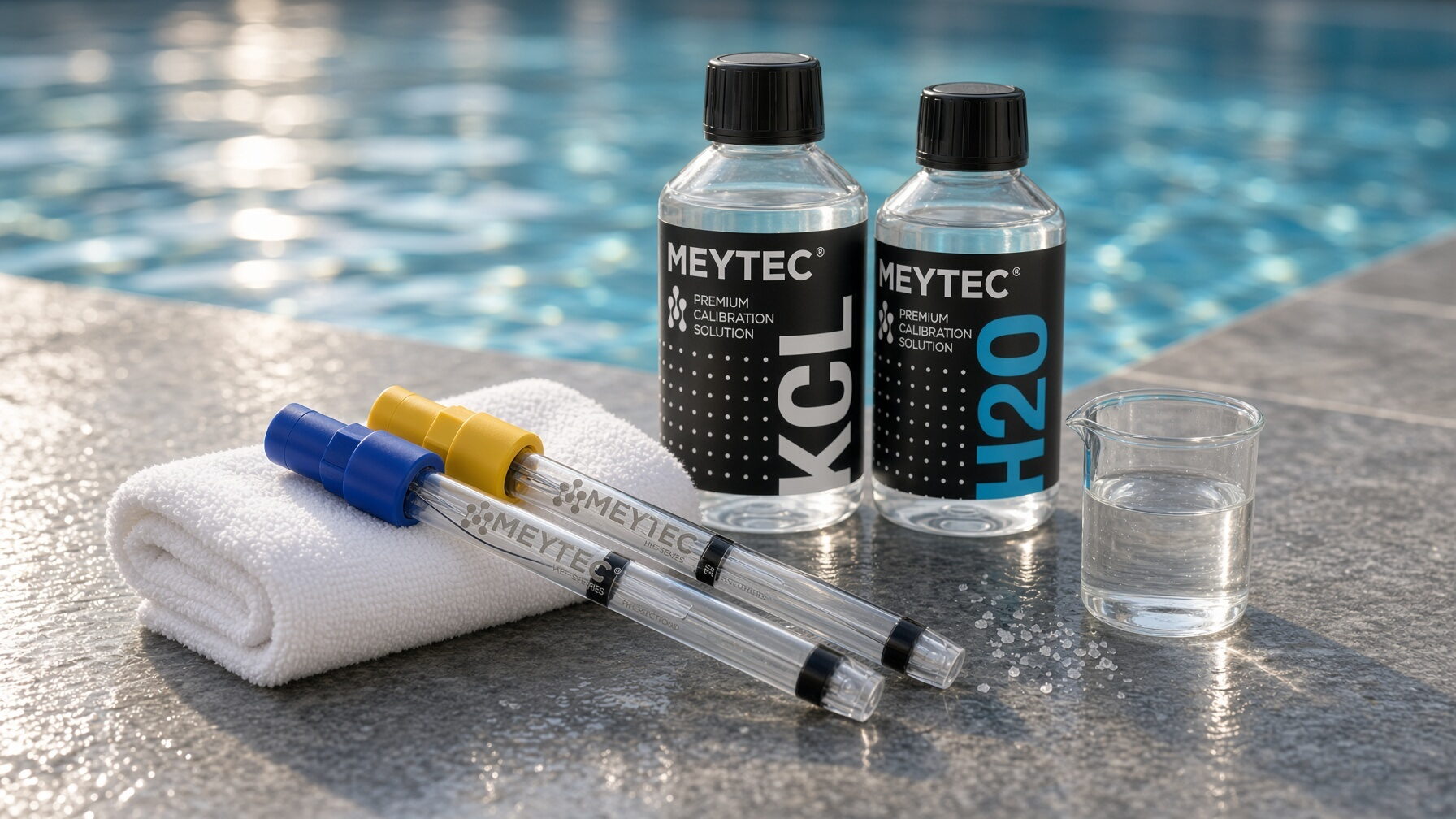
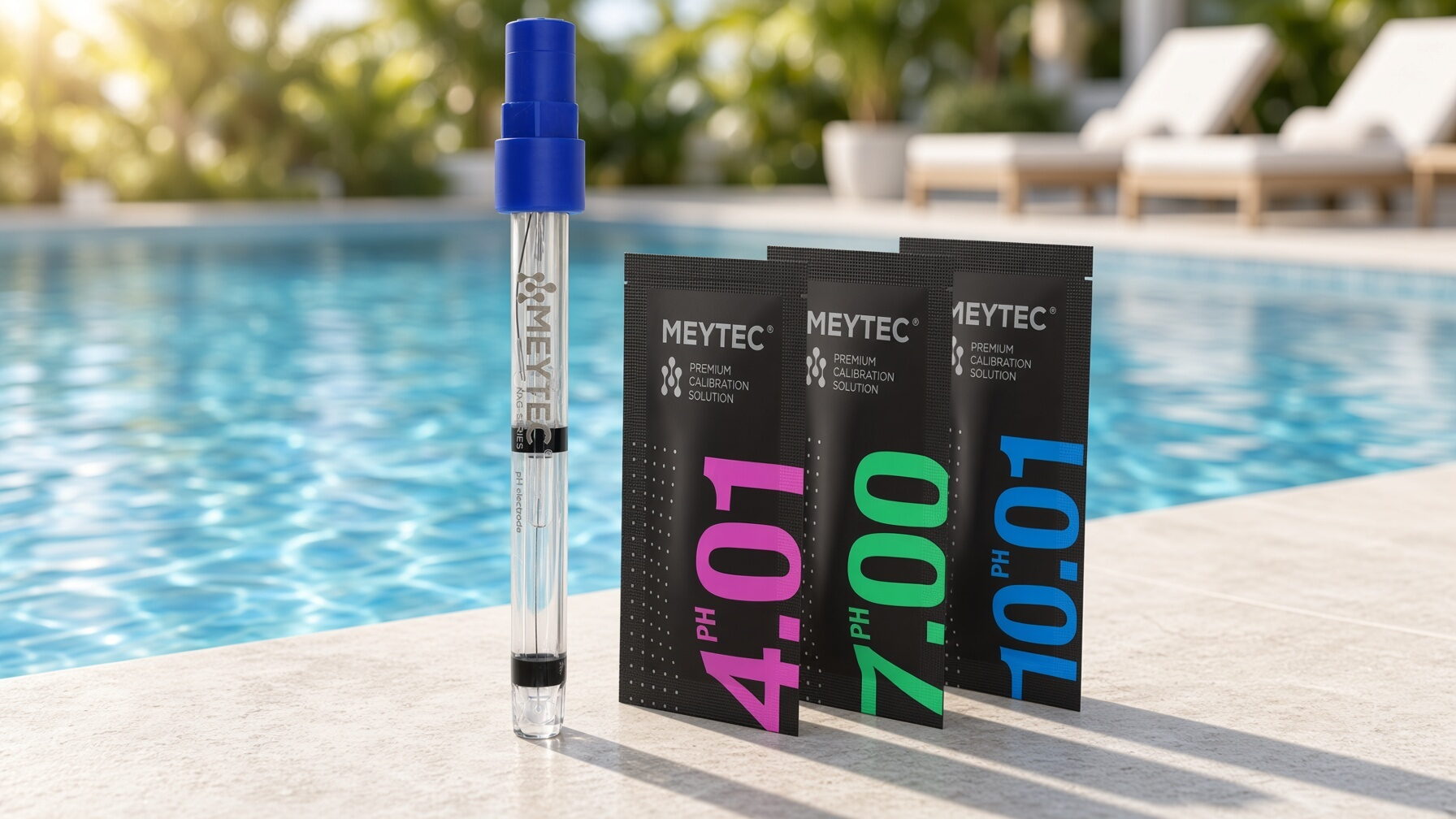
    All pH values from the overview table above are available from Meytec as buffer solutions. This way you calibrate with fresh, stable solution that suits your controller – without having to search at the brand manufacturer.

    pH values (swimming pool and laboratory): pH 4, pH 6.86, pH 7, pH 9, pH 9.18 and pH 10. For most pool controllers, pH 7 plus pH 4 or pH 10 is sufficient (see the table). You will find the full pH range under pH buffer solution.

    Packaging:

    • 250 ml – bottle for regular use and workshops
    • 60 ml – compact bottles, handy as a spare or for seasonal calibration
    • Sachets 20 ml – box of 25×20 ml, ideal for one-off calibrations without an open bottle

    Buffer solutions pH and ORP – ready for two-point calibration plus ORP and storage:

    • Buffer solutions pH and ORP – complete packs with pH 4 + pH 7 + 475 mV + KCl + rinse water, or pH 7 + pH 10 + 475 mV + KCl + rinse water
    • Combination sachets: pH 4 + pH 7, pH 7 + pH 10, and packs with 475 mV (3×10 sachets)

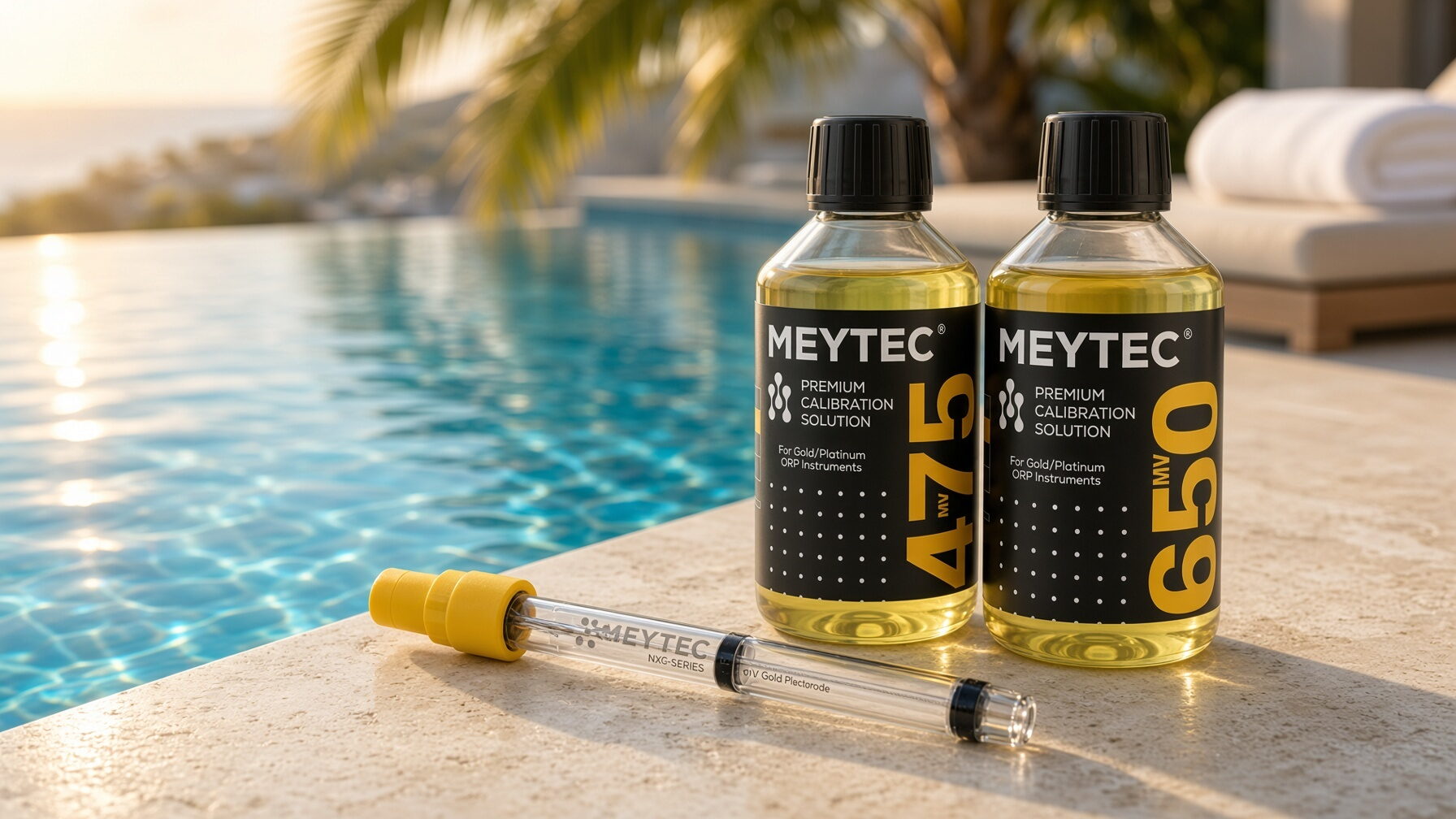
    ORP / redox – for systems that calibrate redox as well as pH (e.g. Zodiac Dual Link, Beniferro): ORP buffer solution in shop values 240 mV, 250 mV, 468 mV, 475 mV and 650 mV, also in 250 ml, 60 ml and (for 475 mV) sachets 25×20 ml.

    Every calibration also involves storage in 3M KCl and – if there are deposits – cleaning before you calibrate. Fast delivery.

    Meytec NXG-PH – universal replacement probe

    The Meytec NXG-PH probe is designed as a cross-brand compatible replacement probe for all the European systems mentioned above.

    Compatibility:

    • Standard BNC connector, compatible with BWT, Sugar Valley, CCEI, AstralPool/Fluidra, Idegis, Avady, Pool Technologie, SCP, Desjoyaux, Irripiscine, Cash Piscines, Hydralians, CF Group, Bayrol, Zodiac, Hayward, ProMinent, Kripsol, Innowater, BSPOOL, Ibercoverpool, Teap, Monarch, Harmo Pool, Beniferro and Stérilor
    • 3M KCl reference electrolyte, identical to the reference systems of all the brands mentioned
    • Suitable for 10–40°C (pool water temperatures)
    • Standard 12 mm or 3/4″ NPT thread, fits common measuring chambers and flow cells
    • pH measuring range 0–14, with high stability and fast response time

    When to use the Meytec NXG-PH?

    • When the original probe is outdated, responds slowly or no longer calibrates
    • As a spare part to avoid downtime caused by delivery delays
    • For maintaining pools with multiple brands, using one probe type

    Installation tips:

    1. Check that the connector type (BNC / digital) matches your controller
    2. After installation, carry out a standard calibration according to the specifications of your system (pH 7 + pH 4, pH 7 + pH 10, or pH 7 as a single point)
    3. Always store the probe in 3M KCl when it is not in use

    Summary

    The pH probe is the heart of every automatic water treatment system. Regular calibration (at least twice per season), correct cleaning and always storing in 3M KCl are essential for stable long-term operation. Whether you use a system from BWT, Sugar Valley, CCEI, AstralPool/Fluidra, Idegis, Avady, Pool Technologie, SCP, Desjoyaux, Irripiscine, Cash Piscines, Hydralians, CF Group, Bayrol, Zodiac, Hayward, ProMinent, Kripsol, Innowater, BSPOOL, Ibercoverpool, Teap, Monarch, Harmo Pool, Beniferro or Stérilor: the Meytec NXG-PH probe offers a reliable, compatible replacement solution so that your pool water always stays in optimal balance.

    Order the pH probe, the matching buffer solution (pH or ORP) or a ready-made pack that your system requires. Do you still have doubts or questions? Contact us. Fast delivery.

  • ORP probe for swimming pools: everything you need to know

    ORP probe for swimming pools: everything you need to know

    What is ORP?

    ORP stands for Oxidation-Reduction Potential, also called redox potential. It is a measure of the ability of water to oxidise substances (give up electrons) or reduce them (take up electrons). In an oxidation-reduction process, one molecule loses electrons while the other takes them up.

    The ORP value is expressed in millivolts (mV). The higher the ORP value, the stronger the oxidising capacity of the water and therefore the more effective the disinfection. A positive ORP value means that the water has an oxidising effect, which is essential for killing bacteria, viruses and other micro-organisms.

    ORP and swimming pools

    In swimming pools, ORP is used as the primary indicator of the disinfection capacity of the water. The World Health Organization (WHO) has for years regarded ORP as the most important parameter for checking whether water is microbiologically safe to swim in.

    The big advantage of ORP over measuring free chlorine is that ORP measures the actual disinfecting power, not just the chlorine concentration. Two swimming pools with the same amount of free chlorine can have a different ORP value, depending on factors such as pH, temperature and the amount of organic material in the water. ORP therefore gives a more direct picture of how effectively the water is being disinfected.

    For a safe and well-disinfected swimming pool, an ORP value between 650 and 750 mV is generally recommended. At a value below 650 mV, disinfection is insufficient and bacteria and algae can develop. The ideal ORP value is between 700 and 750 mV, provided the pH remains between 7.0 and 7.6.

    An important point to note: ORP is strongly pH-dependent. When the pH rises, the ORP value falls, which means that at a higher pH you need more chlorine to maintain the same disinfecting power.

    How do you measure ORP?

    ORP is measured with an ORP probe (also called a redox electrode). This probe consists of a precious metal (platinum or gold) as the measuring electrode and a reference electrode (usually Ag/AgCl). The measurement is based on the potential difference between these two electrodes.

    In practice, the ORP probe is placed in the pool water, often in a flow cell or directly in the pipes. Modern measuring systems also show pH and temperature alongside ORP, giving you a complete picture of the water quality.

    How is disinfectant produced? The difference between liquid chlorine and salt electrolysis

    There are two commonly used ways to disinfect pool water: dosing liquid chlorine and using salt electrolysis.

    Liquid chlorine is added to the pool water as a ready-to-use product. This is a proven method that works quickly and directly. A disadvantage is that liquid chlorine often raises the pH, so you have to add pH minus to keep the water in balance. You will also use several drums of chlorine per season, which in itself makes it more expensive than salt electrolysis.

    Salt electrolysis, on the other hand, produces chlorine on site. The pool water contains a low concentration of salt (sodium chloride). By means of electrolysis in an electrolysis cell, this salt is converted into chlorine, which then disinfects the water. An important advantage of salt electrolysis is that no storage or transport of liquid chlorine is needed. In addition, a salt electrolysis cell also destroys chloramines, which ensures pleasant water quality.

    Both systems ultimately use chlorine as a disinfectant, but the way in which the chlorine is produced and dosed differs. For ORP control it makes no difference in principle: the ORP probe measures the resulting disinfecting power in both cases.

    Swimming pool ORP probe: what is it and how does it work?

    An ORP probe is a sensor that measures the oxidation-reduction potential of the water. The probe consists of a precious metal (platinum or gold) and a reference electrode. When the probe comes into contact with the pool water, a small potential difference arises, which is converted into an mV signal.

    The Meytec NXG-ORP probe is compatible with all common automatic dosing systems on the market that use the standard BNC connection. You can therefore use it as a replacement probe for Hayward, Sugar Valley, Zodiac, Seko, CCEI, Pool Technologie, Avady, Bayrol and more.

    Difference between platinum and gold

    Both platinum and gold are used as the measuring electrode in ORP sensors. The choice between the two depends on the application:

    • Platinum electrodes are used for oxidising reactions (above 500 mV), such as in swimming pools and spas and in drinking water treatment. These are suitable for liquid chlorine, but less suitable (or unsuitable) for swimming pools with salt electrolysis.
    • Gold electrodes are used in a wide range of environments, from industry to swimming pools, and measure oxidising reactions from 100mV to 1000mV. ORP probes with a gold sensor are better suited for use in swimming pools with salt electrolysis.

    Calibrating an ORP probe

    Calibrating an ORP probe is essential to ensure accurate measurements. Unlike pH probes, ORP probes need calibration somewhat less often, but you should check them regularly.

    Calibration (or verification) is recommended:

    • When the ORP probe is new
    • If the probe has not been used for a while (for example after the winter)
    • After cleaning the probe
    • If manual test results differ significantly from the probe reading
    • Annually as part of maintenance

    The calibration procedure is as follows:

    1. Rinse the ORP probe thoroughly with clean water (tap water or demineralised water is fine).
    2. Pour a small amount of ORP buffer solution into a clean container.
    3. Immerse the probe in the solution and wait until the reading stabilises (max. 2 minutes).
    4. Set the meter to the reference value of the buffer solution (usually around 475 mV).
    5. Rinse the probe after calibration and place it back in the pool water.

    You must not reuse ORP buffer solution after use; pour it away and never reuse it.

    ORP buffer solutions

    ORP buffer solutions (also called redox calibration solutions) are available in various reference values. The most commonly used are:

    • 475 mV: this is the most common reference value for swimming pool applications. Meytec offers this buffer solution in 250 ml, 60 ml and 20 ml sachets, specially for ORP meters and controllers in swimming pools, spas and water treatment systems.
    • 468 mV and 650 mV: these ORP values are also available, depending on the measuring range and the application.

    Meytec supplies ORP buffer solutions in various packaging, including 250 ml bottles and handy sachets. For optimal shelf life, it is advisable to pour only a small amount into a clean glass or beaker for each calibration and to close the main bottle immediately after use.

    Also take a look at our calibration packs: with these you have everything, including pH and ORP buffer solution for calibrating your dosing system. The pack also includes cleaning and storage solution for electrodes to keep them in good condition.

    Maintaining an ORP probe: cleaning and storage

    Good maintenance of the ORP probe is crucial for reliable measurements and a long service life.

    Storage

    • Always store the probe moist, in the protective cap, filled with KCl storage solution.
    • Never store the probe in distilled or demineralised water. This draws ions out of the reference cell and damages the probe permanently.
    • Has the probe dried out? Then place it in storage solution for at least an hour (or better: overnight) to rehydrate.

    Cleaning

    • Rinse the probe with clean water after every use (tap water or demineralised).
    • Do not use a cloth or brush on the pH glass or the sensitive ORP sensor. Scratches and static charge can permanently damage the probe.
    • For thorough cleaning, immerse the probe for about 15 minutes in a cleaning solution for electrodes. Meytec offers a special cleaning solution for this.
    • After cleaning, rinse thoroughly with clean water and, if necessary, let the probe rehydrate for an hour in KCl storage solution.

    With good maintenance and regular calibration, your ORP probe will keep measuring reliably for years, so that your pool water always stays safe and clear. Meytec offers a complete range of ORP probes, buffer solutions, cleaning agents and storage solutions to support you.

    Related: pH probe.

  • Pool salt tester: measuring salt content

    Pool salt tester: measuring salt content

    Swimming pools with salt electrolysis: how do they work?

    A saltwater pool is not a chlorine-free pool. It is a pool in which chlorine is produced on site from a small amount of salt. This is done via salt electrolysis: an electrolysis cell in the filtration circuit converts the dissolved sodium chloride (NaCl) into natural chlorine (sodium hypochlorite). Once the chlorine has done its disinfecting work, it turns back into salt. The cycle starts again.

    The big advantage: you no longer need to buy, transport or manually dose chlorine. The system continuously produces a small amount of chlorine, which ensures even water quality. In addition, the water is softer on the skin and eyes, and the typical chlorine smell disappears.

    Why measure the salt content?

    Salt electrolysis only works at the right salt content. Too little salt means that the electrolysis cell cannot produce enough chlorine, putting disinfection at risk. Too much salt can attack the electrolysis cell and metal parts in the swimming pool.

    Moreover, the salt content is not constant. Evaporation, topping up with tap water, rainfall and backwashing the filter constantly change the concentration. Regular measurement is therefore necessary for the system to work correctly.

    What is the ideal salt content?

    The ideal salt content differs per system and per manufacturer. Roughly speaking, there are three categories:

    System type Salt concentration Dosage per m³
    Standard salt electrolysis 3 – 4 g/l (3,000 – 4,000 ppm) 3 – 4 kg
    Hydrolysis / low salt 1 – 1.5 g/l (1,000 – 1,500 ppm) 1 – 1.5 kg
    Intex saltwater system ± 3.25 g/l 3.25 kg

    For comparison: seawater contains about 35 grams of salt per litre. A saltwater pool is therefore 8 to 10 times less salty – you can hardly taste it.

    Most commonly used systems in Europe and their salt levels

    The European market is dominated by a handful of manufacturers, each with their own recommended salt level. With the AquaRite system, Hayward is one of the most common names: the standard model works optimally at 3,200 ppm (about 3.2 g/l), with a working range of 2,700 to 3,400 ppm. Hayward also offers a Low Salt version that needs only 1.5 g/l .

    Zodiac (part of Fluidra) is widespread in Southern Europe with the GenSalt range. The GenSalt OE and OT models require a recommended salt level of 4 g/l, with a minimum of 3 g/l .

    AstralPool, also part of Fluidra, supplies the Sel Pure range. These systems work with a salt concentration of 4 to 5 g/l .

    Pentair’s iChlor and IntelliChlor systems are widely used in both Europe and North America. The ideal salt level is between 3,200 and 3,400 ppm (3.2 – 3.4 g/l), with a working range of 2,800 to 4,500 ppm .

    Sugar Valley stands out with the Oxilife range, which combines hydrolysis with salt electrolysis at an extremely low salt level of just 1 to 1.5 g/l .

    Poolex Turbo Salt is a popular choice for smaller swimming pools. This system works with a low salt level of 3 to 3.5 g/l .

    Intex Krystal Clear is the most common entry-level model for above-ground pools. The system works with a recommended salt level of 2.5 to 3.5 g/l .

    Finally, there are brands such as Waterco (Electrochlor: 4,000 – 6,000 ppm), Davey (ChloroMatic: 3,000 – 6,000 ppm, with a low-salt option from 1,500 ppm) and MagnaPool (a sodium-free mineral salt system based on magnesium and potassium chloride) .

    Please note: the exact target value is always stated in the manual of your specific system. Always consult it for the most accurate dosage.

    Measuring and topping up salt

    You can easily measure the salt content with a digital salt tester. Immerse the tester in the pool water, wait until the value stabilises and read the result in ppm or g/l. 1,000 ppm corresponds to 1 grams per litre.

    Do you want to increase the salt content? First calculate how much salt you need:

    Pool volume (m³) × missing salt difference (kg/m³) = total kg of salt

    For example: a 15 m³ pool with a shortfall of 1 kg/m³ needs 15 kg of salt.

    Always use pure pool salt (99.8% NaCl) without iodine or other additives. Iodine can turn the pool water yellow and damage the electrolysis cell.

    The Meytec salt tester and calibration

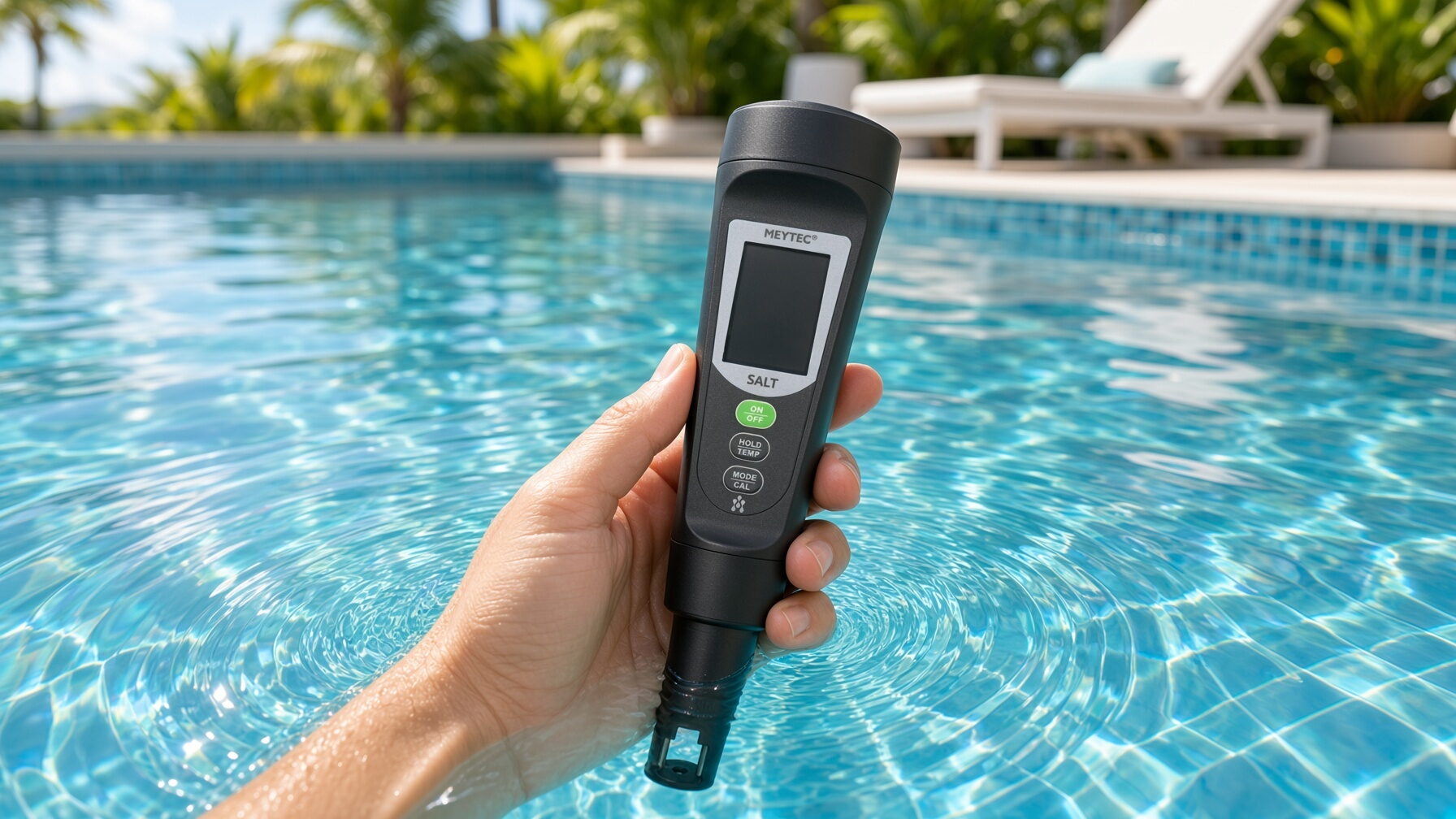
    Meytec offers the GT-500S salt tester for swimming pools, a digital conductivity meter with an integrated temperature sensor. The tester measures salt concentrations from 0 to 10,000 ppm (0 – 10 g/l) and is specially designed for swimming pools with salt electrolysis.

    The GT-500S is easy to use: press the on/off button, immerse the electrode in the water, wait until the measurement stabilises and read the value on the display.

    Calibrating the Meytec salt tester

    For accurate measurements, calibrate the GT-500S regularly with an EC calibration solution.

    • Use 12.88 mS/cm

    Calibration procedure:

    1. Rinse the measuring cell with tap water or demineralised water and shake off excess drops.
    2. Pour a small amount of calibration solution into a clean beaker.
    3. Immerse the measuring cell completely in the solution.
    4. Wait until the value stabilises and hold down the CAL button for 5 to 6 seconds.
    5. The tester automatically recognises the calibration solution and will now calibrate itself.

    Use fresh solution for every calibration and pour away leftovers. Always keep the remaining bottle tightly closed.

    In summary

    With the right salt tester, regular measurements and timely calibration, you keep your salt electrolysis system running optimally – for a clear, soft and safe swimming pool. Meytec offers the GT-500S pool salt tester and matching calibration solutions for accurate measurements in every situation.

    Related: pool salt tester, EC 1413 µS/cm, ORP probe for swimming pools.

  • Maintaining pH and ORP probes: how to keep your measurements reliable

    Maintaining pH and ORP probes: how to keep your measurements reliable

    What are pH and ORP probes?

    A pH probe measures the acidity of the water. In swimming pools, a pH between 7.0 and 7.6 is ideal for both swimmer comfort and the effectiveness of chlorine. In aquariums, a stable pH is crucial for the well-being of fish and plants.

    An ORP probe (redox) measures the oxidation-reduction potential, expressed in millivolts (mV). This value indicates how strongly the water oxidises and therefore how effective the disinfection is. In swimming pools, an ORP between 650 and 750 mV is recommended for safe pool water.

    Both probes work with a glass membrane (pH) or a precious metal such as platinum or gold (ORP) in combination with a reference electrode. They are therefore sensitive to contamination and drying out.

    Why maintenance is necessary

    pH and ORP probes only measure reliably if the glass membrane and the reference junction are clean, hydrated and undamaged. Poor maintenance leads to slow responses, deviating values and a shorter service life.

    In swimming pools and aquariums, electrodes have to deal with:

    • Limescale from hard water
    • Grease and organic contamination (skin oils, sun cream, fish food)
    • Algae and biofilm in warm, humid environments
    • Drying out when the probe is not stored moist

    The result? The offset and slope of the electrode shift, making your measurements slowly but surely unreliable.

    The benefits of good maintenance:

    • Stable, reproducible readings
    • Shorter response time
    • Longer service life of the probe
    • Fewer measurement errors and unnecessary corrections

    How do you clean pH and ORP probes?

    Cleaning is simple, but you need to work carefully. The glass membrane of a pH probe and the sensitive ORP sensor are fragile.

    Why cleaning is really necessary
    A pH or ORP probe is an electrochemical sensor. The measurement takes place at the surface of the glass membrane (pH) or the platinum/gold measuring electrode (ORP). As soon as a layer of limescale, grease, protein or biofilm forms there, the measuring surface becomes isolated from the water. The result: slow response times, deviating values and an offset that falls outside the permitted margin.

    How cleaning solution works
    Cleaning solutions for electrodes tackle this problem in two ways:

    1. Dissolving mineral deposits (limescale)
      Limescale (calcium carbonate) does not dissolve in water. Cleaning solutions therefore contain a mild acid or a chelating compound that binds calcium and magnesium ions. As a result, the limescale layer dissolves without attacking the glass or the reference junction. With a general cleaning solution, this usually takes 15 minutes.
    2. Removing grease, protein and organic material
      Grease and protein contamination (skin oils, sun cream, fish food, algae) adheres to the measuring surface via hydrophobic bonds. Cleaning solutions contain surfactants that break these bonds and bring the contamination into solution. For specific applications there are separate cleaners: protein remover for aquariums with a lot of fish food, grease remover for swimming pools with a lot of sun cream, and alkaline cleaners for meat and fat residues.

    Step 1: Rinse after every use
    Always rinse the probe with clean water (tap water or demineralised). This removes immediate contamination and prevents residues from building up.

    Step 2: Cleaning solution for stubborn deposits
    Immerse the probe for about 15 minutes in a special cleaning solution for electrodes. This effectively removes limescale, grease and biofilm. Meytec offers a cleaning solution specially developed for pH and ORP probes.

    Step 3: Rinse thoroughly and rehydrate if necessary
    After cleaning, rinse the probe thoroughly with clean water. Has the probe dried out badly? Then place it in KCl storage solution for an hour to rehydrate.

    Why not just wipe it with a cloth?
    Rubbing with a cloth or brush can cause microscopic scratches in the pH glass. Every scratch changes the electrical properties of the membrane and causes measurement errors. Static charge on the cloth can also disturb the sensitive measurement. Cleaning solution does the work without mechanical stress.

    Why calibrate after cleaning?
    During calibration, the meter assumes that the probe is clean. If there is still a layer of contamination on the measuring surface, the calibration curve is based on a contaminated surface. As soon as that contamination later comes loose, the calibration is no longer valid. By cleaning first and calibrating afterwards, you can be sure that the offset and slope are correct.

    How do you store pH and ORP probes?

    Storage is perhaps even more important than cleaning. A probe that is stored incorrectly can be permanently damaged within a few days.

    Always store moist
    The glass bulb (pH) and the reference junction (pH and ORP) must always remain moist. Always store the probe in the protective cap filled with KCl storage solution 3 mol/l.

    How storage solution works exactly
    The storage solution, also known as 3 mol/L KCl solution, does three things at once:

    1. Keeping the glass membrane hydrated
      The pH glass of a probe is covered with a so-called swelling layer (hydrated gel layer). This is an ultra-thin layer of about 0.1 micron into which hydrogen ions (H⁺) can penetrate, generating the potential difference that determines the pH. This swelling layer must remain wet at all times. If the probe dries out, the swelling layer disappears, and without a swelling layer the probe no longer measures. Storage solution keeps this layer intact.
    2. Keeping the reference junction open and stable
      The reference electrode (Ag/AgCl) is in contact with the sample water via a porous junction. A small amount of KCl continuously migrates outwards through that junction. If the probe is stored in distilled water, an osmotic effect occurs: the concentrated KCl in the reference cell diffuses into the water, so that the ionic strength in the reference drops and the reference potential shifts. The result is a permanent deviation. Storage solution with 3 mol/L KCl has the same ionic strength as the internal reference solution. There is then no osmotic pressure, and the junction stays open and stable.
    3. Maintaining the correct ion balance
      KCl is used because potassium (K⁺) and chloride ions (Cl⁻) have almost the same mobility. As a result, only a minimal diffusion potential arises at the junction. Other salts, such as NaCl, would cause a measurable deviation.

    Never in distilled water
    Never store the probe in distilled or demineralised water. This draws ions out of the reference cell and damages the probe permanently. It also evaporates faster, which makes the glass dry out.

    Dried-out probe?
    Has the probe dried out anyway? Then place it in storage solution for at least an hour — but preferably overnight — to rehydrate. The swelling layer then hydrates again. If that does not work, the probe is usually permanently damaged.

    Meytec supplies KCl storage solution in various packaging, including 250 ml bottles and handy 20 ml sachets.

    Do not forget to calibrate

    Even with good maintenance, pH and ORP probes need regular calibration. Calibration keeps the probe accurate and limits measurement errors. As explained above: always calibrate after cleaning, so that the offset and slope are set on a clean measuring surface.

    Frequency:

    • Daily use → calibrate daily
    • Occasional use → at least weekly or monthly
    • After cleaning the probe
    • If manual test results differ from the probe reading

    For pH probes, use fresh buffer solution, at least two points: usually pH 4 and 7, or pH 7 and pH 10. Meytec offers buffer solutions in 250 ml, 60 ml and 20 ml.

    For ORP probes, use an ORP buffer solution, for example 475 mV, 468 mV or 650 mV. Meytec supplies these in various packaging, including handy 20 ml sachets.

    Always follow the manual of your measuring device for the exact calibration procedure. Used buffer solution is no longer accurate after about 20 minutes — pour it away and do not reuse it.

    With good maintenance and regular calibration, your pH and ORP probes will keep measuring reliably for years — whether it is a crystal-clear swimming pool or a healthy aquarium. Meytec offers a complete range of probes, buffer solutions, cleaning agents and storage solutions to support you.

    Related: calibration packs, probes.