

 EN-GB
 Nederlands
 Deutsch
 Français
 Español
 Italiano
 Polski
 Svenska
 Deutsch (Belgien)
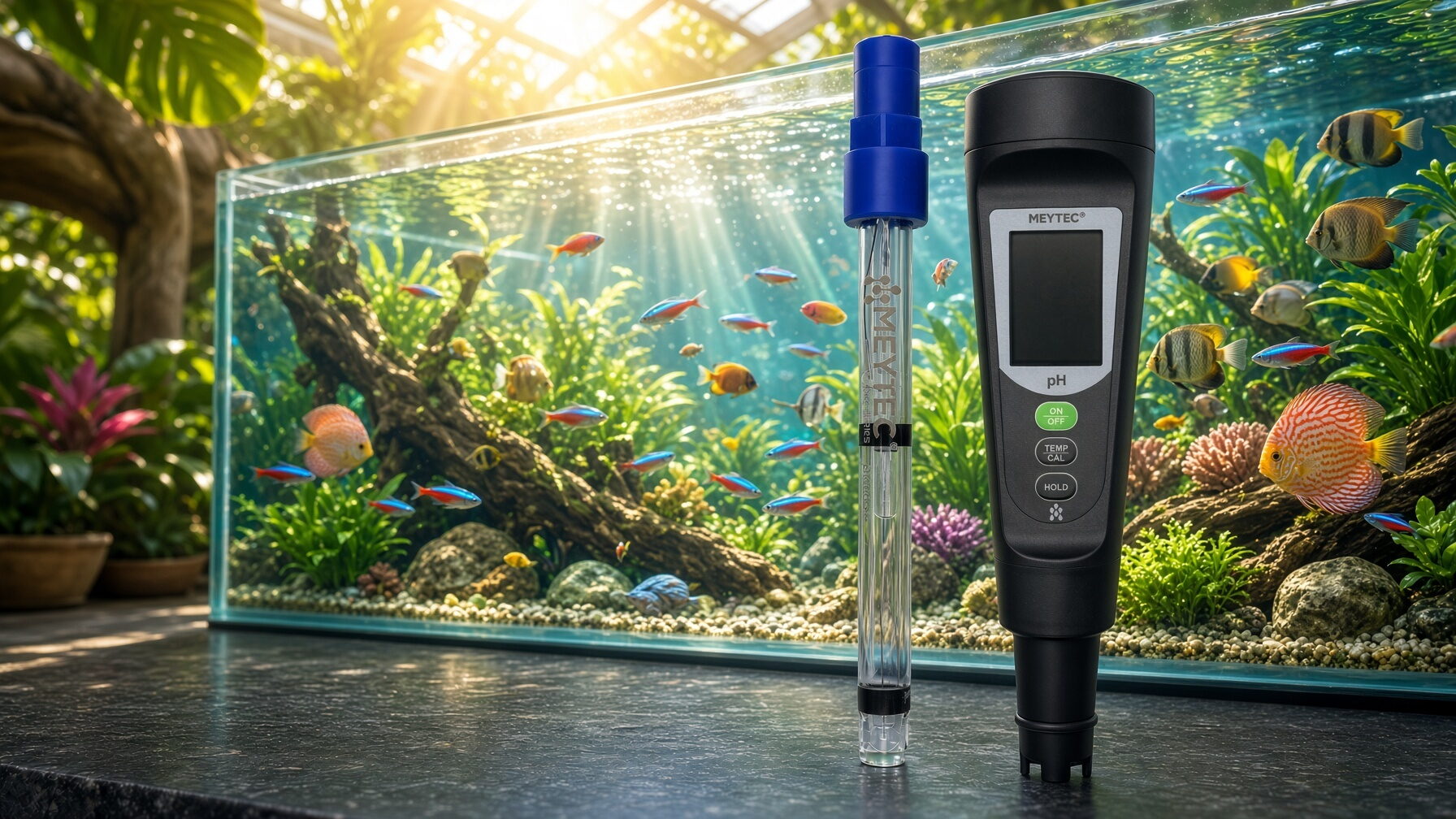
pH and aquariums
Why is pH so important in your aquarium? It determines the health of fish, plants and water quality.
Learn how to measure, calibrate and maintain pH accurately and discover which fish need which pH value.
A stable pH is more important than an exact value.
pH and aquariums: why it is the key to healthy underwater life
A stable pH value is perhaps the most underestimated factor in the aquarium hobby. While many aquarium enthusiasts focus on temperature and feeding, the acidity of the water determines whether fish, plants and beneficial bacteria actually thrive. In this blog we take a deep dive into the world of pH, from the biological necessity to the latest measuring equipment, and look at how Meytec products help keep your aquarium in balance.
Why is pH important for an aquarium?
The pH value indicates how acidic or alkaline the water is, on a scale of 0 to 14. A value of 7 is neutral, lower is acidic and higher is alkaline. But why does this matter so much?
For fish: stress, disease and death
Fish are extremely sensitive to pH fluctuations. A deviation of more than 0.3 pH per day can already cause stress. That stress lowers resistance, makes fish susceptible to disease and in serious cases can even lead to death. In addition, an incorrect pH has a direct influence on the toxicity of ammonia: the higher the pH, the more ammonium converts into toxic ammonia; especially above pH 7.5 the proportion of ammonia increases rapidly. Ammonia is fatal even in small amounts.
For plants: nutrient uptake and growth
Aquatic plants only absorb nutrients well within a certain pH range. At the wrong acidity, essential minerals such as iron and manganese can precipitate, so that plants can no longer absorb them. The result: yellowed leaves, stagnating growth and eventually dying plants. Plants also influence the pH themselves: during the day plants absorb CO₂, causing the pH to rise; at night they release CO₂, causing the pH to fall.
For water quality and the biological filter
The beneficial bacteria in your filter – responsible for converting ammonia into nitrate – work best at a stable pH. Extreme values slow down nitrification, causing harmful substances to build up. A stable pH is therefore not only important for the fish, but for the entire ecosystem in your aquarium.
Big overview: which fish species needs which pH?
The ideal pH differs greatly per fish species. Roughly speaking, there are three categories:
South American species (soft, acidic water)
- Discus: pH 5.5–6.5
- Neon tetras: pH 5.0–7.0
- Cardinal tetras: pH 5.5–7.0
- Dwarf cichlids (Apistogramma): pH 5.5–6.5
- Corydoras: pH 6.0–7.5
Asian and African species (slightly acidic to alkaline)
- African cichlids (Malawi/Tanganyika): pH 7.8–8.5
- Barbs: pH 6.0–7.5
- Danios: pH 6.5–7.5
- Rasboras: pH 6.0–7.0
Community aquarium (widely applicable)
- Most community fish and plants thrive best between pH 6.8 and 7.4
- Goldfish: pH 7.0–7.6
- Livebearers (guppies, platies, swordtails): pH 7.0–8.0
- Angelfish: pH 6.5–7.5
Important: choose fish that suit the pH of your tap water, instead of constantly trying to adjust the pH. A stable pH is more important than an “ideal” pH.
How do you measure pH in an aquarium?
There are several methods for measuring the pH value in an aquarium, each with advantages and disadvantages:
Test strips or drop tests
Cheap, but often inaccurate and subjective due to colour interpretation. Suitable for a rough indication, but not for precision work.
Portable pH meter (handheld)
A compact device that measures the pH value quickly and accurately. Ideal for periodic checks: daily, weekly or whenever you suspect something is wrong. The meter gives a digital value immediately and is easy to calibrate. The portable pH meter GT-500PH is a fast and accurate pH meter that lets you measure the correct pH value in no time and is easy to calibrate automatically.
Fixed pH measuring and control system (pH probe)
A permanently installed system in which the pH probe sits continuously in the aquarium water or in a flow cell. The system measures continuously and can even control the CO₂ supply. The pH probe is the sensitive and most critical component here – a high-quality electrode, correctly maintained and properly calibrated, determines the reliability of your measurements.
The Meytec NXG-PH probe is a durable pH probe with a fast response that is compatible with the majority of systems on the market.
pH dosing devices
Advanced systems that not only measure, but also automatically dose pH correction solution. They combine a pH controller with a dosing pump and are ideal for demanding aquariums. Take a look at Meytec’s pH probes and pH buffer solutions for reliable pH measurement in your aquarium.
Top pH brands in Europe: models and Meytec compatibility
Important: the Meytec NXG-PH probe is compatible with any device that has a BNC input and accepts an electrode with a diameter of 12 mm.
| Brand | Relevant models | Compatible with NXG-PH? | Required Meytec buffer solutions |
|---|---|---|---|
| 1. Hanna Instruments | HI981520 Marine Monitor HI9813-61 BL-7916-2 pH controller with pump BL-981411-0 Mini Panel Mounted pH Controller |
Yes – works with Hanna pH controllers and meters with a BNC input. | pH 7 + pH 10 or pH 4 + pH 7 + pH 10 |
| 2. Milwaukee Instruments | MC122 PRO pH Controller (pH 5.5–9.5) MC125 PRO 2-in-1 pH/ORP Controller MC720 PRO pH Controller with dosing pump |
Yes – replaces the original Milwaukee pH probe. | pH 7 + pH 10 or pH 4 + pH 7 + pH 10 |
| 3. Bluelab | Bluelab pH Controller Pro Controller Connect (Wi-Fi, doses pH and nutrients) |
Yes – works with Bluelab pH controllers with a BNC input. | pH 7 + pH 10 or pH 4 + pH 7 + pH 10 |
| 4. Mettler Toledo | InLab Easy pH probe NineFocus NF2000 HA Kit SevenCompact S220 |
Yes – please note: check whether your Mettler device has a BNC input (not S7). | pH 7 + pH 10 or pH 4 + pH 7 + pH 10 |
| 5. Apera Instruments | PH20 Value PH60 PC60 Premium PC400S |
Probably – devices with a BNC input and 12 mm electrode are compatible. Always check the specifications. | pH 7 + pH 10 or pH 4 + pH 7 + pH 10 |
| 6. TUNZE | SmartController 7000 pH-Controller 7070/2 pH/CO₂ Controller 7074/2 |
Probably – TUNZE uses its own pH probes. If your system has a BNC input and accepts a 12 mm electrode, the NXG-PH is compatible. | pH 7 + pH 10 or pH 4 + pH 7 + pH 10 |
| 7. EHEIM | pHcontrol+e (pH 0–14, control range pH 6–9, day/night control, guided calibration, CO₂ valve control via Wi-Fi) | Possibly – the pHcontrol+e uses its own pH sensor. Check the connection before purchase. | pH 7 + pH 10 or pH 4 + pH 7 + pH 10 |
| 8. GHL | ProfiLux 4.1e ProfiLux 4 ProfiLux Mini WiFi PLM-pH/Redox expansion card with BNC input |
Probably – the PLM-pH/Redox card has a BNC input. Check the specifications of your GHL configuration. | pH 7 + pH 10 or pH 4 + pH 7 + pH 10 |
| 9. Dennerle | pH probe (gel electrode, 3 m cable, BNC) CO2 pH probe with Quali-Safe protection |
Yes – Dennerle uses a BNC connection and is suitable for all pH measuring devices with BNC. | pH 7 + pH 10 or pH 4 + pH 7 + pH 10 |
| 10. Metrohm | Aquatrode Plus 913 pH Meter 780/781 pH/Ion Meter Ecotrode Plus Pt1000 |
Possibly – Metrohm often uses S7 or banana plugs. Check whether your Metrohm device has a BNC input. | pH 7 + pH 10 or pH 4 + pH 7 + pH 10 |
| 11. JBL | PROFLORA pH-Control Touch PROFLORA CO₂ pH SENSOR SET pH-Control (BNC connection for pH sensor) |
Yes – the JBL pH-Control and PROFLORA pH-Control Touch have a BNC connection for the pH sensor. The NXG-PH (BNC, 12 mm) is a direct replacement. | pH 7 + pH 10 or pH 4 + pH 7 + pH 10 |
| 12. Sera | seramic pH Controller sera pH meter sera pH-Controller sera CO2-Controller sera pH measuring electrode (BNC, 1.5 m cable) |
Yes – the sera pH measuring electrode has a BNC plug and is compatible with sera pH meters and seramic controllers. The NXG-PH is a full alternative. | pH 7 + pH 10 or pH 4 + pH 7 + pH 10 |
| 13. Aqua Medic | pH computer set (incl. pH probe with BNC) pH controller (pH 3.5–12.5, BNC connection) pH monitor pH/Redox controller CO2 controller pH probe |
Yes – the Aqua Medic pH controller has a BNC connection for electrodes. The NXG-PH is a direct replacement. | pH 7 + pH 10 or pH 4 + pH 7 + pH 10 |
Meytec GT-500PH and NXG-PH: your pH partners
Meytec offers two products that are perfectly suited to the needs of the aquarium hobbyist:
Meytec GT-500PH pH meter
The GT-500PH is a compact digital pH meter that measures pH from 0.00 to 14.00 with a precision of ±0.05. It has a built-in temperature sensor with automatic temperature compensation and a dust-tight housing that is resistant to water jets (IP65, not for full immersion) – ideal for use around the aquarium. Automatic calibration at pH 7, pH 4 and pH 10 makes the device user-friendly, even for beginners. Batteries (4× LR44) are included.
Meytec NXG-PH pH probe
The NXG-PH is a professional pH probe with a BNC connection, a diameter of 12 mm and a 3 metre cable. It measures pH 0.00–14.00 with a precision of 0.01 pH and works at temperatures of 0–80°C. The double junction and double Ag/AgCl reference ensure stable, reliable measurements.
Compatibility: where do these Meytec products fit?
The GT-500PH is a standalone handheld meter: it works independently and can be used immediately in any aquarium.
The NXG-PH is compatible with, among others:
- Hanna Instruments (pH controllers and meters with BNC input)
- Milwaukee Instruments (pH controllers)
- Mettler Toledo (devices with BNC input)
- JBL (pH measuring systems)
- Bluelab (pH controllers)
Maintenance and calibration: the key to accuracy
A pH probe is a sensitive sensor. With the right maintenance, you can extend its service life considerably:
- Always store the probe in the protective cap with KCl 3 mol/l storage solution. Never in demineralised water, never dry
- Clean the probe with cleaning solution to remove deposits (max. 15 minutes), always before calibration
- Calibrate when you first use it and regularly after that. First pH 7, then pH 4 or pH 10. Follow the manual of your meter or dosing system
Conclusion
With its BNC connection, 12 mm diameter and 3 metre cable, the Meytec NXG-PH probe is a universal pH probe that is compatible with most pH measuring and control systems on the European market. Whether you use a JBL PROFLORA pH-Control Touch, sera seramic pH Controller, Aqua Medic pH computer set, Hanna controller, Milwaukee dosing system or Bluelab pH Controller: as long as your device has a BNC input and accepts a 12 mm electrode, the NXG-PH is an excellent choice.
For correct calibration, use the Meytec buffer solutions: pack pH 7 + pH 10 + 475 mV for two-point calibration on the alkaline side, pH 4 + pH 7 for the acidic side, or pH 4 + pH 7 + 475 mV for systems that also measure ORP. Do not forget to store the probe in KCl 3 mol/l storage solution after use and to clean it with the Meytec cleaning solution before calibration.


