

 EN-IE
 Nederlands
 Deutsch
 Français
 Español
 Italiano
 Polski
 Svenska
 Deutsch (Belgien)
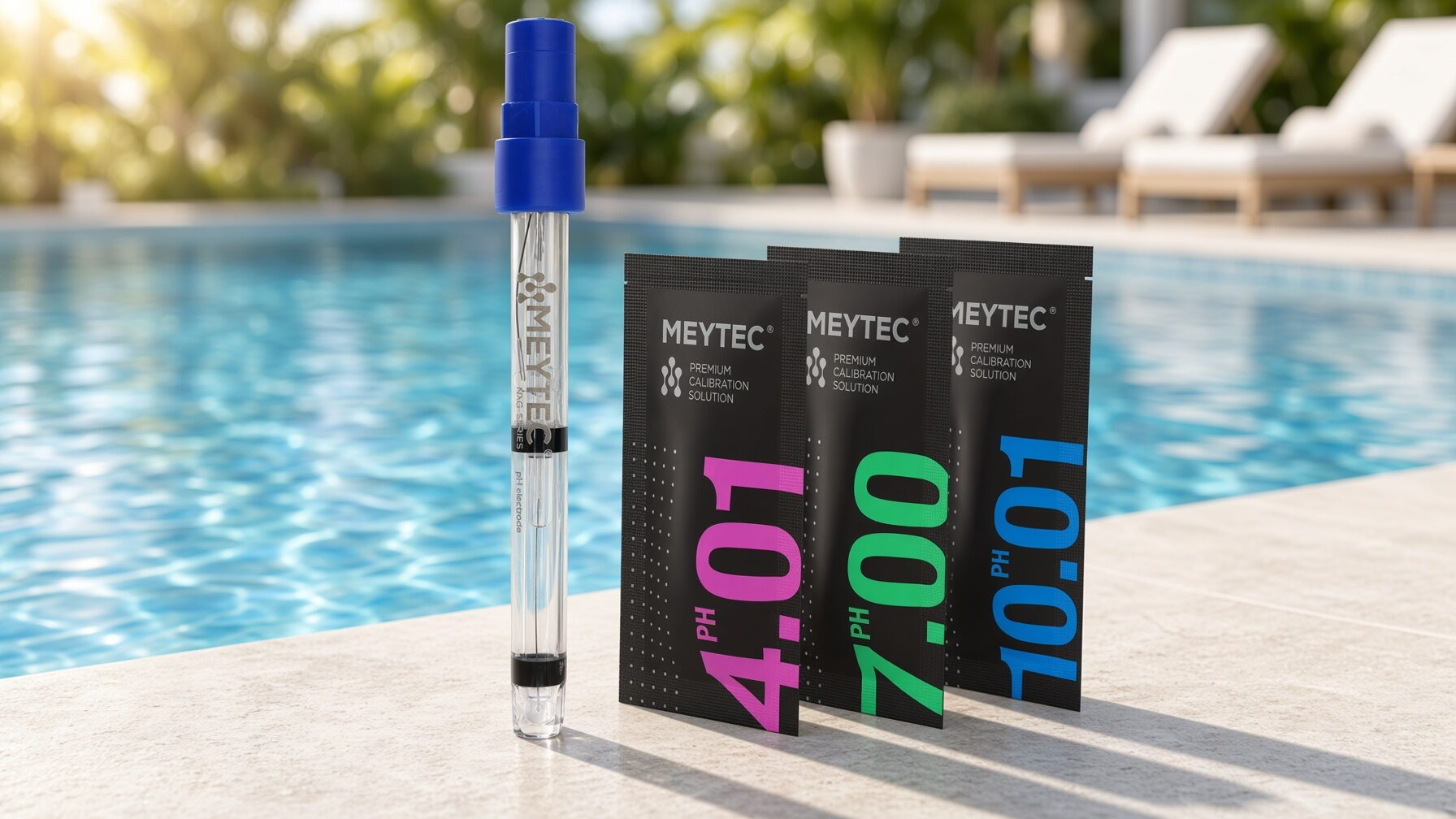
Calibrating a swimming pool pH probe: a complete guide
A correctly calibrated pH probe is crucial for clear pool water and optimal operation of your dosing system. This comprehensive guide covers the operation, cleaning, calibration and storage of pH probes. You will also find a complete overview of the most popular European pH control systems – from BWT and Hayward to Sugar Valley and Kripsol – with their required pH values.
Calibrating a pH probe for swimming pools: what is a pH probe?
A pH probe is an electrochemical sensor that measures the concentration of hydrogen ions (H⁺) in water. It is a glass probe consisting of a measuring electrode (a pH-sensitive glass membrane) and a reference electrode (usually a silver/silver chloride wire in a 3M KCl solution). The potential difference between the two is converted into a pH value.
Why does a swimming pool pH probe need to be calibrated?
The glass membrane and the reference electrode become contaminated over time by minerals, grease and disinfection by-products. This causes the measurement to drift. In pool water this happens faster due to chlorine, limescale and sunscreen. Without calibration, a deviation of 0.1 to 0.3 pH can already lead to incorrect dosing of chemicals, resulting in cloudy water, reduced chlorine effectiveness and corrosion of equipment. In a swimming pool, the pH should be between 7.2 and 7.6: that is where chlorine works best and the water stays pleasant for skin and eyes. Advice: calibrate at least twice per season (at start-up and halfway through).
How does a pH probe work in an automatic dosing system?
Measure → Compare → Dose
The pH probe continuously measures the pH in the pool’s pipe circuit. The controller compares the measured value with the set value. If there is a deviation, the dosing pump starts: pH- (acid) if the pH is too high, pH+ (base) if the pH is too low. Modern systems dose proportionally: the greater the deviation, the longer the pump runs. Always check the settings of your pH dosing system to make sure you never overdose. Most devices let you set a limit. Bear in mind that it will take several minutes or longer before the injected pH passes the measuring chamber again. It is better to make several small corrections than 1 large one.
Cleaning the pH probe
If there are deposits of algae, grease or limescale on the pH probe, it responds slowly. First clean with cleaning solution for probes. Maximum 15 minutes. Then rinse with clean water. Demineralised water may be used for rinsing, never for storage. Vinegar or household products do not belong on a pH probe. Only calibrate after cleaning, never before.
The complete calibration procedure
What you need to calibrate a swimming pool pH probe
What you need: pH 7 buffer solution (calibration solution), pH 4 buffer solution (or pH 10 buffer solution, depending on the system), tap water or demineralised water, soft cloth.
Step-by-step plan: calibrating a swimming pool pH probe in 6 steps
- Switch off the circulation pump and the dosing system.
- Remove the probe and rinse the bulb with tap water or demineralised water.
- Immerse in pH 7 buffer solution, wait until the value stabilises (30–60 s), confirm on the controller.
- Rinse again and carefully dab dry.
- Immerse in pH 4 buffer solution (or pH 10, see per system), wait for stabilisation and confirm.
- Rinse, put back and restart the system. After an hour, check with a separate pH meter whether the pH of the pool is between 7.2 and 7.6.
Note: buffer solutions change value with temperature. Always consult the temperature table on the label and preferably calibrate at a temperature close to that of the pool water. So do not leave the bottles in the sun at the edge of the pool.
Storing a pH probe: why KCl?
The glass membrane needs a hydrated gel layer to be able to measure H⁺. Storing it dry breaks down this layer, causing the impedance to rise and the response to deteriorate permanently. 3M KCl keeps the gel layer intact, prevents the diaphragm from drying out and is compatible with the reference electrolyte. Never store the probe in distilled water, tap water or a dry environment. Fill the protective cap with KCl storage solution 3 mol/l until the glass bulb and the junction are covered. When you winterise the pool, remove the probe from the measuring chamber and store it this way, protected from frost.
Which pH value for calibrating a swimming pool pH probe?
The exact pH value you need to calibrate your pH probe differs from manufacturer to manufacturer. Many systems use pH 7 as the neutral point, supplemented with pH 4, pH 9 or pH 10. Other systems require calibration at 4.01, 6.86 and 9.18; there pH 6.86 is the neutral point. Whether you calibrate at 1, 2 or 3 points is stated in the manual of your system.
Below is an overview of the most common systems and the pH value you need.
Overview: brands, buffer solutions and pH values
| Manufacturer | System | Buffer solution |
|---|---|---|
| AstralPool / Fluidra | Control Connect / Smart Next / eXO iQ | pH 7 + pH 4 |
| Avady | PROpilot / MasterBox / Physico / PANduo | pH 7 (1 point) |
| Bayrol | Automatic pH / Cl-pH / Salt | pH 7 (1 point) |
| Beniferro | Wifipool Twin / Duo / Quatro | pH 7 + 468 mV |
| BSPOOL | EVO / PRO / KIT AUTO | pH 7 (1 point) or pH 7 + pH 4 |
| BWT | Manager Connect Duo / EasyDose / EDP 5.5 | pH 7 (1 point) or pH 7 + pH 4 (2 points) |
| Cash Piscines | Racer / Racer Compact / 1er Prix | pH 7 + pH 10 |
| CCEI | Phileo VP / Phileo LT | pH 7 (1 point) |
| CF Group | pH Connect / Centrale de Contrôle | pH 7 + pH 10 |
| Desjoyaux | JD PH Techno / JD pH / JD Regul | pH 7 (1 point) |
| Harmo Pool | Duo / Duo LS / Quatro | pH 7 (1 point) |
| Hayward | HCC 2000 / AquaRite Pro / NEO PH / LTO | pH 7 + pH 4 |
| Hydralians | Aquaprimo pH | pH 7 (1 point) |
| Ibercoverpool | S Lux Salt / Premium pH | pH 7 + pH 10 |
| Idegis | Tecno DT S2+ / Domotic LS / Elite Connect | pH 7 (1 point) |
| Innowater | pH-Redox Controller / Pool Monitor | pH 7 + pH 4 |
| Irripiscine | Simply IRRIPOOL / STI IV / iSALT | pH 7 + pH 4 |
| Kripsol | KLX / K-Pool PH / Serie ECO | pH 7 + pH 10 (+ neutral) |
| Monarch | Ecomatic / Chloromatic | pH 7 (1 point) |
| Pool Technologie | Poolsquad / Pro pH / Justsalt Duo | pH 7 + pH 10 |
| ProMinent | DULCOMETER Compact / D1C / D2C | pH 7 + pH 4 |
| SCP | Prim PH Evol / Star pH | pH 7 (1 point) |
| Stérilor | EVO Salt / XP (pH module) | pH 7 (1 point) |
| Sugar Valley | Hidrolife / Oxilife / Bionet | pH 7 + pH 10 |
| Teap | Saliclor Serie L (pH / pH+Redox) | pH 7 (1 point) |
| Zodiac | pH Expert / pH Perfect / Dual Link | pH 7 + pH 4 (+ 475 mV) |
Meytec buffer solutions for pH and ORP
All pH values from the overview table above are available from Meytec as buffer solutions. This way you calibrate with fresh, stable solution that matches your controller – without searching at the brand manufacturer.
pH values (swimming pool and laboratory): pH 4, pH 6.86, pH 7, pH 9, pH 9.18 and pH 10. For most pool controllers, pH 7 plus pH 4 or pH 10 is sufficient (see the table). You will find the complete pH assortment under pH buffer solution.
Packs:
- 250 ml – bottle for regular use and workshops
- 60 ml – compact bottles, handy as a spare or for seasonal calibration
- 20 ml sachets – box of 25×20 ml, ideal for one-off calibrations without an open bottle
Calibration sets – ready for two-point calibration plus ORP and storage:
- Calibration sets pH and ORP – complete packs with pH 4 + pH 7 + 475 mV + KCl + rinse water, or pH 7 + pH 10 + 475 mV + KCl + rinse water
- Combination sachets: pH 4 + pH 7, pH 7 + pH 10, and sets with 475 mV (sachets 3×10)
ORP / redox – for systems that calibrate redox as well as pH (including Zodiac Dual Link, Beniferro): ORP buffer solution in shop values 240 mV, 250 mV, 468 mV, 475 mV and 650 mV, also in 250 ml, 60 ml and (for 475 mV) sachets 25×20 ml.
Every calibration also involves storage in 3M KCl and – in case of deposits – cleaning before you calibrate.
Meytec NXG-PH – universal replacement probe
The Meytec NXG-PH probe is designed as a cross-brand compatible replacement probe for all the European systems mentioned above.
Compatibility:
- Standard BNC connector, compatible with BWT, Sugar Valley, CCEI, AstralPool/Fluidra, Idegis, Avady, Pool Technologie, SCP, Desjoyaux, Irripiscine, Cash Piscines, Hydralians, CF Group, Bayrol, Zodiac, Hayward, ProMinent, Kripsol, Innowater, BSPOOL, Ibercoverpool, Teap, Monarch, Harmo Pool, Beniferro and Stérilor
- 3M KCl reference electrolyte, identical to the reference systems of all brands mentioned
- Suitable for 10–40°C (pool water temperatures)
- Standard 12 mm or 3/4″ NPT thread, fits common measuring chambers and flow cells
- pH measuring range 0–14, with high stability and fast response time
When to use the Meytec NXG-PH?
- When the original probe is outdated, responds slowly or no longer calibrates
- As a spare part to avoid downtime due to delivery delays
- For maintenance of pools with several brands, where one probe type is used
Installation tips:
- Check that the connector type (BNC / digital) matches your controller
- After installation, carry out a standard calibration according to the specifications of your system (pH 7 + pH 4, pH 7 + pH 10, or pH 7 as a single point)
- Always store the probe in 3M KCl when it is not in use
Summary
The pH probe is the heart of every automatic water treatment system. Regular calibration (at least twice per season), correct cleaning and always storing in 3M KCl are essential for stable long-term operation. Whether you use a system from BWT, Sugar Valley, CCEI, AstralPool/Fluidra, Idegis, Avady, Pool Technologie, SCP, Desjoyaux, Irripiscine, Cash Piscines, Hydralians, CF Group, Bayrol, Zodiac, Hayward, ProMinent, Kripsol, Innowater, BSPOOL, Ibercoverpool, Teap, Monarch, Harmo Pool, Beniferro or Stérilor: the Meytec NXG-PH probe offers a reliable, compatible replacement solution so that your pool water always stays in optimal balance.
Order the pH probe, the matching buffer solution (pH or ORP) or a ready-made set that your system requires. Do you still have doubts or questions? Contact us.


