

 EN-IE
 Nederlands
 Deutsch
 Français
 Español
 Italiano
 Polski
 Svenska
 Deutsch (Belgien)
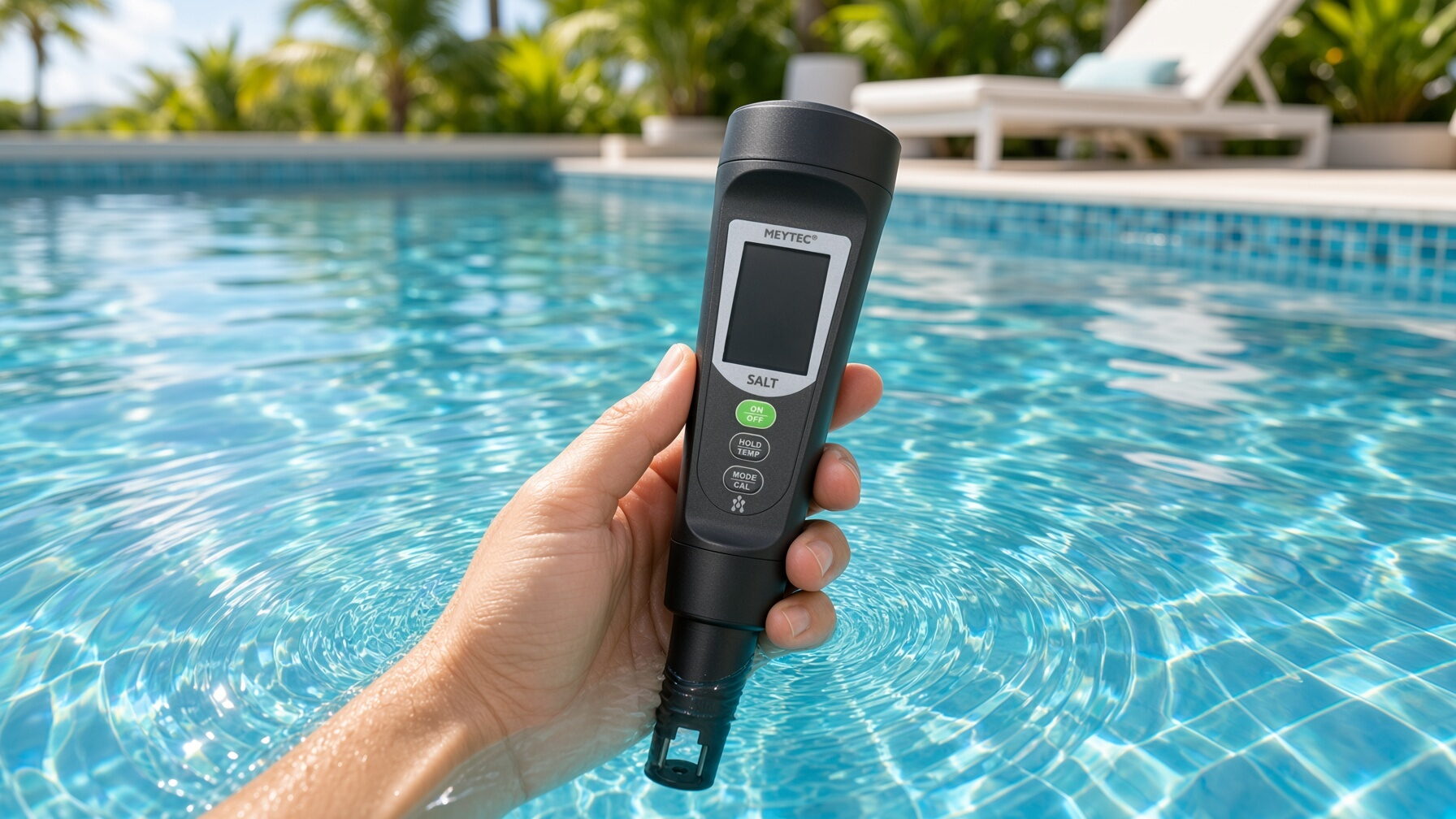
Pool salt tester: measuring salt content
A saltwater pool with salt electrolysis produces chlorine on site from a small amount of salt. The right salt content is crucial: too little results in insufficient disinfection, too much can damage the electrolysis cell. So measure regularly with a digital salt tester and top up with pure pool salt. Meytec offers the GT-500S salt tester for swimming pools. That way you keep your system running optimally for clear and soft pool water.
Swimming pools with salt electrolysis: how do they work?
A saltwater pool is not a chlorine-free pool. It is a pool in which chlorine is produced on site from a small amount of salt. This is done via salt electrolysis: an electrolysis cell in the filtration circuit converts the dissolved sodium chloride (NaCl) into natural chlorine (sodium hypochlorite). Once the chlorine has done its disinfecting work, it turns back into salt. The cycle starts again.
The big advantage: you no longer need to buy, transport or manually dose chlorine. The system continuously produces a small amount of chlorine, which ensures even water quality. In addition, the water is softer on the skin and eyes, and the typical chlorine smell disappears.
Why measure the salt content?
Salt electrolysis only works at the right salt content. Too little salt means that the electrolysis cell cannot produce enough chlorine, putting disinfection at risk. Too much salt can attack the electrolysis cell and metal parts in the swimming pool.
Moreover, the salt content is not constant. Evaporation, topping up with tap water, rainfall and backwashing the filter constantly change the concentration. Regular measurement is therefore necessary for the system to work correctly.
What is the ideal salt content?
The ideal salt content differs per system and per manufacturer. Roughly speaking, there are three categories:
| System type | Salt concentration | Dosage per m³ |
|---|---|---|
| Standard salt electrolysis | 3 – 4 g/l (3,000 – 4,000 ppm) | 3 – 4 kg |
| Hydrolysis / low salt | 1 – 1.5 g/l (1,000 – 1,500 ppm) | 1 – 1.5 kg |
| Intex saltwater system | ± 3.25 g/l | 3.25 kg |
For comparison: seawater contains about 35 grams of salt per litre. A saltwater pool is therefore 8 to 10 times less salty – you can hardly taste it.
Most commonly used systems in Europe and their salt levels
The European market is dominated by a handful of manufacturers, each with their own recommended salt level. With the AquaRite system, Hayward is one of the most common names: the standard model works optimally at 3,200 ppm (about 3.2 g/l), with a working range of 2,700 to 3,400 ppm. Hayward also offers a Low Salt version that needs only 1.5 g/l .
Zodiac (part of Fluidra) is widespread in Southern Europe with the GenSalt range. The GenSalt OE and OT models require a recommended salt level of 4 g/l, with a minimum of 3 g/l .
AstralPool, also part of Fluidra, supplies the Sel Pure range. These systems work with a salt concentration of 4 to 5 g/l .
Pentair’s iChlor and IntelliChlor systems are widely used in both Europe and North America. The ideal salt level is between 3,200 and 3,400 ppm (3.2 – 3.4 g/l), with a working range of 2,800 to 4,500 ppm .
Sugar Valley stands out with the Oxilife range, which combines hydrolysis with salt electrolysis at an extremely low salt level of just 1 to 1.5 g/l .
Poolex Turbo Salt is a popular choice for smaller swimming pools. This system works with a low salt level of 3 to 3.5 g/l .
Intex Krystal Clear is the most common entry-level model for above-ground pools. The system works with a recommended salt level of 2.5 to 3.5 g/l .
Finally, there are brands such as Waterco (Electrochlor: 4,000 – 6,000 ppm), Davey (ChloroMatic: 3,000 – 6,000 ppm, with a low-salt option from 1,500 ppm) and MagnaPool (a sodium-free mineral salt system based on magnesium and potassium chloride) .
Please note: the exact target value is always stated in the manual of your specific system. Always consult it for the most accurate dosage.
Measuring and topping up salt
You can easily measure the salt content with a digital salt tester. Immerse the tester in the pool water, wait until the value stabilises and read the result in ppm or g/l. 1,000 ppm corresponds to 1 grams per litre.
Do you want to increase the salt content? First calculate how much salt you need:
Pool volume (m³) × missing salt difference (kg/m³) = total kg of salt
For example: a 15 m³ pool with a shortfall of 1 kg/m³ needs 15 kg of salt.
Always use pure pool salt (99.8% NaCl) without iodine or other additives. Iodine can turn the pool water yellow and damage the electrolysis cell.
The Meytec salt tester and calibration
Meytec offers the GT-500S salt tester for swimming pools, a digital conductivity meter with an integrated temperature sensor. The tester measures salt concentrations from 0 to 10,000 ppm (0 – 10 g/l) and is specially designed for swimming pools with salt electrolysis.
The GT-500S is easy to use: press the on/off button, immerse the electrode in the water, wait until the measurement stabilises and read the value on the display.
Calibrating the Meytec salt tester
For accurate measurements, calibrate the GT-500S regularly with an EC calibration solution.
- Use 12.88 mS/cm
Calibration procedure:
- Rinse the measuring cell with tap water or demineralised water and shake off excess drops.
- Pour a small amount of calibration solution into a clean beaker.
- Immerse the measuring cell completely in the solution.
- Wait until the value stabilises and hold down the CAL button for 5 to 6 seconds.
- The tester automatically recognises the calibration solution and will now calibrate itself.
Use fresh solution for every calibration and pour away leftovers. Always keep the remaining bottle tightly closed.
In summary
With the right salt tester, regular measurements and timely calibration, you keep your salt electrolysis system running optimally – for a clear, soft and safe swimming pool. Meytec offers the GT-500S pool salt tester and matching calibration solutions for accurate measurements in every situation.
Related: pool salt tester, EC 1413 µS/cm, ORP probe for swimming pools.


